
Angels –vs- Evil
California Women
Lose Case Against Federal Bullies
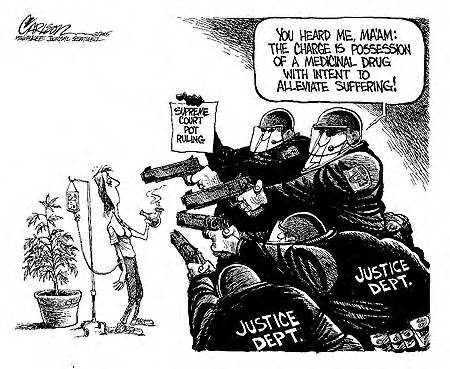
Visit: http://www.raichaction.org/ and http://www.angeljustice.org
Please contact senators and reps and Tell them to support HR
2087 State's right to medical marijuana act. Here is MPP's press release from May 4, 2005 on the latest bill.
http://www.mpp.org/releases/nr20050504.html
Pdf and html versions of the syllabus, majority opinion, and
dissents of the decision are now
online here:
http://straylight.law.cornell.edu/supct/html/03-1454.ZS.html
and the official version should be here at some point:
http://www.supremecourtus.gov/opinions/04slipopinion.html
SUGGESTED ACTIONS IN
RESPONSE TO THE RAICH DECISION
*********************PLEASE
COPY AND DISTRIBUTE*************************
DrugSense FOCUS Alert #309 - Monday, 6 June 2005
The Supreme Court ruled Monday that state medical marijuana laws don't protect users from a federal ban on the drug - allowing federal authorities to prosecute sick people for their use of medical cannabis, even if on the advice of their doctors.
The decision is on line in various formats here http://straylight.law.cornell.edu/supct/html/03-1454.ZS.html and as a 79 page .pdf file here http://www.supremecourtus.gov/opinions/04pdf/03-1454.pdf
In its majority opinion against Raich and Monson (page 6), the Supreme Court issued a significant word of warning about the wisdom of current federal laws:
"The case is made difficult by respondents' strong arguments that they will suffer irreparable harm because, despite a congressional finding to the contrary, marijuana does have valid therapeutic purposes. The question before us, however, is not whether it is wise to enforce the statute in these circumstances; rather, it is whether Congress' power to regulate interstate markets for medicinal substances encompasses the portions of those markets that are supplied with drugs produced and consumed locally."
**********************************************************************
Organizations are calling for you to act and providing detailed advice on the best ways to respond. Please see:
http://actioncenter.drugpolicy.org/action/index.asp?step=2&item=25197
http://www.norml.org/index.cfm?Group_ID=6550
**********************************************************************
Here are a few points to consider:
The single most important thing to understand is that state and local laws on the books protecting medical cannabis patients and their doctors will continue to stand and are not at all affected by this ruling.
As you can see from this split decision, the Court has ruled on very technical legal grounds, particularly on medical cannabis as a commerce issue. However, we are heartened that the Court was clear in recognizing the medical necessity for seriously ill patients like Angel.
The Attorney General and the federal government now have a choice: They can choose to continue wasting taxpayers' dollars raiding the homes of sick and dying patients-- suffering from diseases like cancer, chronic pain, leukemia, multiple sclerosis and AIDS--who are abiding by state and local laws, or they can choose more worthwhile priorities, like national security or arresting terrorists. The federal government should not compound the suffering of sick and dying patients.
The federal government actually makes only 1% of all marijuana related arrests in the country. While 99% protection from arrest isn't perfect, it is still substantial. It is more urgent than ever before for states to act to protect patients from arrests and harassment.
**********************************************************************
The press will have a field day with this story - and will likely make factual errors in their reporting which will enhance your chances of being published if you write letters. Expect many targets for letters to the editor in the days ahead.
Please check this link frequently, watching for news clippings with a "Pubdate" of Mon, 06 Jun 2005 or later, to help you find targets for your letters:
http://www.mapinc.org/topics/Raich
**********************************************************************
Thanks for your effort and support.
It's not what others do it's what YOU do
**********************************************************************
Additional suggestions for writing LTEs are at our Media Activism Center:
http://www.mapinc.org/resource/
Or contact MAP Media Activism Facilitator Steve Heath for personal tips on how to write LTEs that get printed.
**********************************************************************
PLEASE SEND US A COPY OF YOUR LETTER
Please post a copy of your letter or report your action to the sent letter list (sentlte@mapinc.org) if you are subscribed, or by E-mailing a copy directly to heath@mapinc.org if you are not subscribed. Your letter will then be forwarded to the list so others can learn from your efforts.
Subscribing to the Sent LTE list (sentlte@mapinc.org) will help you to review other sent LTEs and perhaps come up with new ideas or approaches as well as keeping others aware of your important writing efforts.
To subscribe to the Sent LTE mailing list see
http://www.mapinc.org/lists/index.htm#form
**********************************************************************
Prepared by: Stephen Heath, MAP Media Activism Facilitator
From: Rick Bayer [mailto:ricbayer@comcast.net]
Sent: Monday, June 06, 2005 3:43 PM
Cc: Grant Higginson, MD; Senator Bill Morrisette
Subject: California A.G Lockyer's statement re: Raich case
Oregon DoJ
Attention: Hardy Myers, Attorney General
Dear: Mr. Myers:
I was told today that the Oregon Medical Marijuana Program (OMMP) was no longer issuing permit cards until receiving advice from the Oregon AG office. I was a chief petitioner of Oregon's Medical Marijuana Law in 1998 and see no reason to stop issuing permits because of Raich decision.
The California AG has issued a press release today to calm down concerned Californians so I forwarded that below. Can we in Oregon have a press release from our AG?
Excessive delay of a calming opinion from the Oregon AG's office will only continue to frighten patients, cause fewer to register, and will increase the number of unregistered growers. This will make more work for Law Enforcement (LE) at a greater expense to taxpayers as these unregistered sick people are busted and processed. The human misery in totally unnecessary.
As we all know, 99% of marijuana arrests are by state and local authorities - not the feds. The OMMP is very important for patients with debilitating conditions and most Oregonians have no problems with the OMMP (about 70 to 80% of Oregonians like our medical marijuana act in the last polling).
It is the best interest of all stakeholders (patients, doctors, politicians, administrators, and LE too) to encourage registration and compliance. Please allow OMMP to start re-issuing cards and please put out a press release in a manner that will calm patients. The news media have spooked some people and although I have spoken to media all day, something from the Oregon AG's office will help. As the California AG proved, this is not an impossible task. Please contact me if I can provide any assistance. Thank you.
Sincerely,
Richard E. Bayer, MD
6800 SW Canyon Drive
Portland, OR 97225
(503) 292-1035 voice
(503) 297-0754 fax
cc: Grant Higginson, MD, Oregon DHS OMMP Director
cc: Senator Bill Morrisette, Oregon Senate
=======================
Don't let Oregon shut
down medical marijuana program
Although the U.S. Supreme Court ruled earlier today that federal authorities can continue prosecuting medical marijuana patients, Oregon's medical marijuana law is still intact. But you wouldn't know that from the alarming, inaccurate statement of one Oregon official. Grant Higginson, M.D. — the public health officer who oversees the Oregon Medical Marijuana Program (OMMP) — incorrectly concluded that the Court's ruling invalidates state medical marijuana laws, and he has decided to stop issuing medical marijuana registration cards.
We need you to do three things, right now, to set the record straight.
The Marijuana Policy Project vehemently opposes Higginson's decision to break Oregon's law by unilaterally deciding to withhold medical marijuana ID cards from legitimate patients. In fact, if Higginson refuses to follow state law and continue issuing ID cards to legitimate patients, MPP will immediately sue him in state court. Meanwhile, we need you to do your part.
So please call Dr. Higginson, Attorney General Myers, and write to your local papers today.
Higginson said that Oregon will continue to receive and process applications, but he explained, "We need to proceed cautiously until we understand the ramifications of this ruling." Higginson has contacted the attorney general to ask for a formal legal opinion on how the ruling affects OMMP. Unfortunately, Dr. Higginson does not yet understand that the Court's decision does not invalidate Oregon's law in any way.
The attorneys general of California, Nevada, and Montana have already said that their states' medical marijuana laws are unaffected by today's Supreme Court ruling, and the attorneys general of the six other medical marijuana states have also not challenged their states' policies. Please visit http://www.ag.ca.gov/newsalerts/2005/05-040.htm to read California Attorney General Bill Lockyer's statement on the legitimacy of his state's medical marijuana law, and his commitment to uphold it.
Oregon's law reflects the will of the people, since voters
in Oregon passed it. And the law maintains its legality in the face of the
Supreme Court's disappointing decision. Please take action today to ensure that
Oregon state officials understand this fact, and please pass this message along to your
friends and family in Oregon, so that they may act too. Thank you for
supporting the Marijuana Policy Project.
NEWS RELEASE
Attorney General Bill Lockyer
California Department of Justice www.ag.ca.gov
FOR IMMEDIATE RELEASE Contact: Teresa Schilling
June 6, 2005 05-041 (916) 324-5500
ATTORNEY GENERAL
LOCKYER ISSUES STATEMENT ON US
SUPREME COURT'S
MEDICAL MARIJUANA RULING
(SACRAMENTO) - Attorney General Bill Lockyer today issued the following statement on today's ruling by the U.S. Supreme Court in Gonzales v. Raich, which holds that federal laws prohibiting the use of medical marijuana remain in effect regardless of state laws that permit its use:
"Today's ruling does not overturn California law permitting the use of medical marijuana, but it does uphold a federal regulatory scheme that contradicts the will of California voters and limits the right of states to provide appropriate medical care for its citizens. Although I am disappointed in the outcome of today's decision, legitimate medical marijuana patients in California must know that state and federal laws are no different today than they were yesterday.
"Californians spoke overwhelmingly in favor of medical marijuana by passing Proposition 215, the Compassionate Use Initiative, and that law still stands in our state. Unfortunately, federal law continues to criminalize the use of physician-recommended marijuana medicine. This conflict between state and federal law means that seriously ill Californians will continue to run the risk of arrest and prosecution under federal law when they grow or use marijuana as medicine.
"Today's ruling shows the vast philosophical difference between the federal government and Californians on the rights of patients to have access to the medicine they need to survive and lead healthier lives. Taking medicine on the recommendation of a doctor for a legitimate illness should not be a crime.
"There is something very wrong with a federal law that treats medical marijuana the same as heroin. The United States Congress and the President have the power to reform and modernize federal law in order to bring relief to medical patients and still punish those who illegally traffic in substances. Patients, physicians and the public that support medicinal marijuana should tell their Congressional Representatives and Senators to take a fresh look at the federal laws that ban its use."
####
Calif. AG: Don't Panic Over Pot
Ruling
By KIM CURTIS
.c The Associated Press
SAN FRANCISCO (AP) - Oregon stopped issuing medical marijuana cards after
Monday's Supreme Court ruling, but people could apparently still get pot with a
doctor's prescription there and in nine other states. And nobody in law
enforcement appeared eager to make headlines arresting ailing patients.
``People shouldn't panic. There aren't going to be many changes,'' California
Attorney General Bill Lockyer said. ``Nothing is different today than it was
two days ago, in terms of real-world impact.''
The high court ruled 6-3 that people who smoke marijuana because their doctors
recommend it to ease pain can be prosecuted for violating federal drug laws.
The ruling does not strike down medical marijuana laws in California, Alaska,
Colorado, Hawaii, Maine, Montana, Nevada, Oregon, Vermont or Washington state.
State and local authorities in most of those states said they have no interest
in arresting people who smoke pot for medical reasons.
It remains to be seen whether the federal Drug Enforcement Administration is
planning a crackdown. The Justice Department was not commenting.
In Oregon, state officials said they would temporarily stop issuing medical
marijuana cards to sick people.
``We want to proceed cautiously until we understand the ramifications of this
ruling,'' said Grant Higginson, a public health officer who oversees Oregon's
medical marijuana program.
Medical marijuana dispensaries have proliferated despite a 2001 Supreme Court
ruling that rejected the ``medical necessity'' defense in marijuana cases.
Paul Armentano of the National Organization for the Reform of Marijuana Laws
said arrests of ailing patients have been rare, but the government has arrested
more than 60 people in medical marijuana raids since September 2001.
Most of those arrests have been in California - the first state to allow
medical marijuana, in 1996. On Monday, Gov. Arnold Schwarznegger, who has
previously supported use of pot by sick people, said only: ``It is now up to
Congress to provide clarity.''
Still, the ruling makes Valerie Corral nervous. Corral operates a 150-plant pot
farm in Santa Cruz County, providing marijuana for free to about 165 seriously
ill members. Her farm was raided by the DEA in 2002. The high court's decision
``leaves us protecting ourselves from a government that should be protecting
us,'' she said.
It was ``business as usual'' at the San Francisco health department,
spokeswoman Eileen Shields said. The county issues medical marijuana
identification cards, valid for two years, to residents with a doctor's
prescription. Currently, 8,200 residents have the cards.
In Colorado, where 668 people hold certificates that let them use and grow
marijuana for pain relief under a constitutional amendment voters approved in
2000, federal prosecutors will continue to focus on large drug rings, but if
investigators come across marijuana in the possession of certified state users,
they will seize it - just as they have always done, said Jeff Dorschner, a U.S.
Attorney's spokesman.
In Montana, the 119 residents who paid $200 to get on the state's confidential
registry won't face state prosecution, said state Attorney General Mike
McGrath. He said the state is not obligated to help federal authorities
prosecute people following state law.
In Nevada, medicinal pot users are already warned that the state law offers no
protections from federal prosecution, Attorney General Brian Sandoval said.
Dear
Oregon,
The important thing to remember about this bad result is that nothing will change in Oregon. The Feds have not been leaving us mostly alone because of fear that they were powerless, but for some other reason.
And the most powerful lesson is to be found in this quote from Justice Stevens:
Stevens said there are other legal options for patients, "but perhaps even more important than these legal avenues is the democratic process, in which the voices of voters allied with these respondents may one day be heard in the halls of Congress."
I submit that we are well underway in the process of having our voices heard-the combined efforts of mmj states will be the voices heard in Congress. Oregon will be showing the way again.
Our effort to bring about rescheduling will continue through this session and then into the inter-session at the pharmacy board. Rescheduling would radically change the sentencing structure for mj crimes.
So we do not like to lose something like this, but it will spur us on the win the rest. Use this impetus to speak polite fire at the 2693 hearing!
Laird Funk
This setback is an opportunity to educate.
I just read the Supreme Court ruling in Raich v. Gonzales. opinion and the message is quite clear. These quotes from the Opinion of the Court summarize the ruling:
"The question presented in this case is whether the power vested in Congress by Article I, Section 8, of the Constitution...includes the power to prohibit the local cultivation and use of marijuana in compliance with California law."
"The case is made difficult by respondents' strong arguments that they will suffer irreperable harm because, despite a congressional finding to the contrary, marijuana does have valid therapeutic purposes."
"Well settled law controls our answer. The CSA is a valid exercise of federal power, even as applied to the troubling facts of this case."
"We do note, however, the presence of another avenue of relief. As the Solicitor General confirmed during oral argument, the statute authorizes procedures for the reclassification of Schedule I drugs. BUT PERHAPS EVEN MORE IMPORTANT THAN THESE LEGAL AVENUES IS THE DEMOCRATIC PROCESS, IN WHICH THE VOICES OF VOTERS ALLIED WITH THESE RESPONDENTS MAY ONE DAY BE HEARD IN THE HALLS OF CONGRESS." (my EMPHASIS)
We need to pursue all avenues of rescheduling marijuana and we need to get Congress to change the federal law. Starting locally we need to all contact our Congress people and use this decision to urge them to act. We need a long term plan to get this job done working with all the national organizations.
We need to maximize this opportunity to focus on the issue.
John Sajo
For immediate release
For more information
contact:
Steven S. Epstein, Esq.
The Supreme Court's decision
is not the end of the fight
The
decision of the Supreme Court concluding that the federal marijuana
prohibition does not violate the Commerce Clause as applied to Angel Raich
and Diane Monson is not the end of the political fight.
Support
for legalizing the medical use of marijuana has never been greater.
Just
this past May Republicans Ron Paul (TX) and Dana Rohrbacher (CA) and Democrats
Barney Frank (MA) and Sam Farr (CA), reintroduced the States' Rights to
Medical Marijuana Act. This bill, assigned bill number HR 2087, has
been introduced in each of the last several sessions of Congress, and has
gained increased support and co-sponsorship each time around.
HR
2087 bill would reverse today's decision. It proposes rescheduling
marijuana under federal law so those states that wish to legalize the
medical use of marijuana under state law could do so without federal
interference. If this bill were approved by Congress, federal prosecution
of patients who qualify for medical use under state law would end, and
states could actually provide medical marijuana to patients who
qualify under state law.
Last
session 5 of Massachusetts' 10 representatives signed on as
sponsors. They were Rep. Barney Frank (D, MA-4); Michael Capuano
(D, MA-8); William Delahunt (D, MA-10); John Olver (D, MA-1); and, James
P. McGovern (D, MA-3). The five who did not were Richard Neil (D
MA-2); Marty Meehan (D MA-5); John Tierney (D MA-6); John Markey (D MA-7);
and, Stephen Lynch (D MA-9).
Even though they did not sign on, except for Mr. Lynch, the other members of
the Massachusetts delegation have twice voted in favor of
prohibiting the Justice Department from spending funds to interfere with the
implementation of state medical marijuana laws. House Roll
Call No. 420, 108th Congress, 1st Session and House Roll Call No. 334,
108th Congress, 2nd Session.
Tomorrow a 1:00 PM the Judiciary Committee of the legislature will be
considering a bill that would amend Massachusetts' Controlled Substance
Thereapuetic Act (G.L. c. 94D) to make it like that in the ten states whose
citizens are now fair game for federal prosecution.
On Wednesday at noon, their
will be small demonstrations outside many U.S. Representatives local offices.
<end>
Massachusetts Cannabis
Reform Coalition\NORML
A State Affiliate of the National Organization for the Reform of Marijuana Laws
Proud Sponsor of Freedom Rally XVI, Sept. 17, 2005 on the Boston Common
P.O. Box 0266, Georgetown, MA 01833-0366
781-944-2266 - http://www.masscann.org/
"We shall by and by want a world of hemp more for our own
consumption."
John Adams as Humphrey Ploughjogger, 1763
NORML People, no doubt most of you have heard of the US Supreme Court decision 6-3 in favor of the government, (O'Conner, Renquist, and Thomas dissenting) in that medical marijuana is illegal under Federal Law.
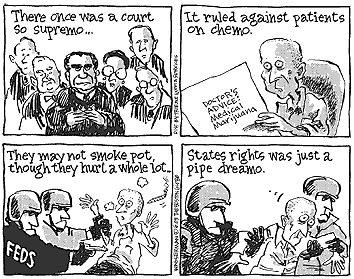
As your leader, I was on WJR, WWJ, Detroit News, National Radio, Metro Times, etc. today, so pardon me for not posting something earlier.
I told the media that this is a very sad day, with so many problems confronting this country from terrorists, hard core criminals and seriously dysfunctional persons, that Federal resources will continue to be used to persecute sick persons who need this medicine, under a doctors care.
In reality, state and local laws are what they are. That is, some protection for the sick is better then nothing. Local laws in Detroit and Ann Arbor still stand, as they do in California, Oregon, Nevada, Maine and 7 other states which are with us.
Local and State Police as appropriate, are agents of the state and local authorities. They are not federal agents. Voter power is where it's at. Medical marijuana was passed in California in 1996, and that law was always in conflict with federal law. When Bush/Ashcroft decided to continue to arrest medical mj patients, a lawsuit was filed against the government and the people won in the 9th Circuit Federal Court. So, for two years, the Feds. could not arrest sick people in the western USA states that passed these laws.
Unfortunately, they can now start doing so again
My friends, some protection from federal tyranny is better then nothing.
I hope our activists in Ferndale, Flint and Traverse City will continue the fight and not lose heart.
My suggestion as head of Michigan NORML, is that we proceed as planned with ballot initiatives in Ferndale, Flint and Traverse City.
Tim Beck
Executive Director, MI-NORML
First National Building
660 Woodward Ave., Ste. 1141
Detroit, MI 48226
(313) 881-8995
June 6, 2005
To: NORML Supporters
From: Allen St. Pierre, Executive Director, NORML
Hello,
Today the United States Supreme Court ruled that federal law continues to prohibit the use of cannabis?even for the sick, dying and sense-threatened.
The first Associated Press story related to this morning's breaking news is found below along with NORML's reply.
As Justice Steven's writings for the court below indicate: "Perhaps even more important than these legal avenues is the democratic process, in which the voices of voters allied with these respondents may one day be heard in the halls of Congress."
It is hard to argue with Justice Stevens' point. Per usual, the greatest gains for cannabis law reform are to be made by achieving legislative changes in the law rather than looking to the courts for relief. In light of this, it is imperative that you contact your member of Congress today and urge him or her to support the States' Rights To Medical Marijuana Act, which would reschedule marijuana under federal law and protect patients in states with medical marijuana laws. Please take two minutes to send your member of Congress a pre-written letter today by visiting:
http://capwiz.com/norml2/mail/oneclick_compose/?alertid=7531001
Thirty-three years after NORML launched the 'medical marijuana' debate by suing the federal government to re-schedule cannabis, regrettably that debate will apparently continue do to this morning's United States Supreme Court decision.
Challenges to cannabis prohibition laws are principally funded by citizens who support a change in the status quo regarding cannabis so please continue to provide the valuable resources, to NORML and other cannabis law reform groups, which are needed to keep pushing hard for these social reforms.
Regards,
-Allen F. St. Pierre
Executive Director
NORML
Washington, DC
#########################################
Court Rules Against Pot for Sick People
By GINA HOLLAND
The Associated Press
WASHINGTON (AP) - Federal authorities may prosecute sick people who smoke pot on doctors' orders, the Supreme Court ruled Monday, concluding that state medical marijuana laws don't protect users from a federal ban on the drug.
The decision is a stinging defeat for marijuana advocates who had successfully pushed 10 states to allow the drug's use to treat various illnesses.
Justice John Paul Stevens, writing the 6-3 decision, said that Congress could change the law to allow medical use of marijuana.
The closely watched case was an appeal by the Bush administration in a case that it lost in late 2003. At issue was whether the prosecution of medical marijuana users under the federal Controlled Substances Act was constitutional.
Under the Constitution, Congress may pass laws regulating a state's economic activity so long as it involves "interstate commerce'' that crosses state borders. The California marijuana in question was homegrown, distributed to patients without charge and without crossing state lines.
Stevens said there are other legal options for patients, "but perhaps even more important than these legal avenues is the democratic process, in which the voices of voters allied with these respondents may one day be heard in the halls of Congress.''
California's medical marijuana law, passed by voters in 1996, allows people to grow, smoke or obtain marijuana for medical needs with a doctor's recommendation. Alaska, Colorado, Hawaii, Maine, Montana, Nevada, Oregon, Vermont and Washington state have laws similar to California.
In those states, doctors generally can give written or oral recommendations on marijuana to patients with cancer, HIV and other serious illnesses.
In a dissent, Justice Sandra Day O'Connor said that states should be allowed to set their own rules.
"The states' core police powers have always included authority to define criminal law and to protect the health, safety, and welfare of their citizens,'' said O'Connor, who was joined by other states' rights advocates.
The legal question presented a dilemma for the court's conservatives, who have pushed to broaden states' rights in recent years, invalidating federal laws dealing with gun possession near schools and violence against women on the grounds the activity was too local to justify federal intrusion.
O'Connor said she would have opposed California's medical marijuana law if she was a voter or a legislator. But she said the court was overreaching to endorse "making it a federal crime to grow small amounts of marijuana in one's own home for one's own medicinal use.''
The case concerned two seriously ill California women, Angel Raich and Diane Monson. The two had sued then-U.S. Attorney General John Ashcroft, asking for a court order letting them smoke, grow or obtain marijuana without fear of arrest, home raids or other intrusion by federal authorities.
Raich, an Oakland woman suffering from ailments including scoliosis, a brain tumor, chronic nausea, fatigue and pain, smokes marijuana every few hours. She said she was partly paralyzed until she started smoking pot. Monson, an accountant who lives near Oroville, Calif., has degenerative spine disease and grows her own marijuana plants in her backyard.
06/06/05 10:31 EDT
#########################################
NORML press release (6/6/05)
Supreme Court Rules Feds Can Arrest State-Recognized Medical Cannabis Patients
State Laws Authorizing Physician-Supervised Use Of Marijuana Unaffected By Ruling
Washington, DC: The US Supreme Court today reversed a Ninth Circuit Court of Appeals decision which found that the federal prosecution of patients who cultivate and possess marijuana for their own medicinal use is an unconstitutional exercise of Congress' Commerce Clause authority. As a result, the court struck down an injunction barring the Justice Department from arresting the respondents -- California medical cannabis patients Angel McClary Raich and Diane Monson -- for violating the federal Controlled Substances Act. Ms. Raich and Ms. Monson had filed suit in federal court in 2002 seeking to bar the US Justice Department from taking legal action against them for their state-sanctioned use of medicinal cannabis.
"While we are disappointed with the Court's decision, the bottom line is that state and local laws protecting medicinal cannabis patients and their physicians remain in place and are unaffected by this ruling," NORML Executive Director Allen St. Pierre said. Eleven states -- Alaska, California, Colorado, Hawaii, Maine, Maryland, Montana, Nevada, Oregon, Vermont and Washington -- have passed laws exempting patients who use cannabis under a physician's supervision from state criminal penalties.
"With this ruling, Congress and the Justice Department have a choice: They can choose to waste taxpayers' dollars and undermine states' rights by arresting and prosecuting seriously ill patients who possess and use medical cannabis in compliance with state law, or they can choose more worthwhile priorities, like protecting national security and targeting violent criminals," St. Pierre said. He added that Congress is expected to vote later this month on a bipartisan amendment sponsored by Reps. Dana Rohrabacher (R-CA) and Maurice Hinchey (D-NY) that would prohibit the federal government from spending taxpayers' dollars to prosecute patients who comply with their state's medical marijuana laws. Also pending in Congress is House Bill HR 2087, "the States' Rights to Medical Marijuana Act," sponsored by Reps. Barney Frank (D-MA), Ron Paul (R-TX), Sam Farr (D-CA), Rohrabacher, and Hinchey, along with 31 co-sponsors, which would reclassify marijuana under federal law to properly recognize its medical utility and enable physicians to legally prescribe it under controlled circumstances.
"The Court's decision today underscores the need for Congress to amend federal law to recognize cannabis' therapeutic utility," St. Pierre said." Throughout our history, the public has looked to state legislatures and Congress -- not the courts -- to be the architects of public policy. With 80 percent of Americans as well as numerous health organizations, including the American Nurses Association and the American Public Health Association, in favor of legalizing the physician-supervised use of medicinal cannabis, it's time for the federal government to butt out of doctors' decisions regarding which medicine is the most safe and effective for their patients."
Respondents co-counsel, NORML Legal Committee member David Michael agreed. "This decision is a great leap backwards by the Supreme Court, in eroding the Rehnquist Court№s Commerce Clause legacy and creating chaos by pitting the Federal Government against its own citizens and their individual states," he said. "Where the Supreme Court has failed, it is now up to Congress to protect the citizens of this country and their states from an overreaching federal government."
For more information, please contact either Allen St. Pierre or Paul Armentano at (202) 483-5500. Respondents' co-counsel, NORML Legal Committee member David Michael is also available for comment at (415) 621-4500.
####################
Check out the newly redesigned NORML store, complete with brand new retro NORML shirts, hats, mugs, and more! Until June 14, get $5 off orders of $50 or more. Coupon Code: GRDAD05 > * visit: http://www.cafeshops.com/norml
NORML Media Watch
NORML was featured prominently in several media outlets this week, including The Cincinnate Enquirer, The Columbia Missourian, and The Pasadena Star News. To read these articles or about other NORML media appearances, check out "NORML in the Media" at:
http://www.norml.org/index.cfm?Group_ID=5481
Donate today to NORML's long-standing efforts to end pot prohibition!
https://secure.norml.org/join/
Sign up for NORML's monthly pledge program today!
https://secure.norml.org/join/pledge.html
####################
Newshawk: Please Write LTEs www.mapinc.org/alert/0309.html
Pubdate: Tue, 07 Jun 2005
Source: New York Times (NY)
Copyright: 2005 The New York Times Company
Contact: letters@nytimes.com
Website: http://www.nytimes.com/
Details: http://www.mapinc.org/media/298
Author: Dean E. Murphy
Note: Mindy Sink contributed reporting from Denver for this article.
Cited: Drug Policy Alliance http://www.drugpolicy.org
Cited: Drug Enforcement Administration http://www.usdoj.gov/dea/
Cited: Drug Free America Foundation http://www.dfaf.org/
Cited: Californians for Drug Free Youth http://www.cadfy.org/
Cited: Oregon Medical Marijuana Program http://www.oregon.gov/DHS/ph/ommp/
Bookmark: http://www.mapinc.org/topics/Raich
Bookmark: http://www.mapinc.org/mmj.htm (Cannabis - Medicinal)
Bookmark: http://www.mapinc.org/people/Epis (Bryan Epis)
DRUG'S USERS SAY RULING WON'T END THEIR EFFORTS
OAKLAND, Calif. - Advocates of medicinal uses of marijuana suffered a legal setback on Monday in the United States Supreme Court, but there was little panic or despair amid the tears of disappointment.
"Just because we lost this little battle does not mean that the war is over," Angel McClary Raich, one of the marijuana users whose case was before the Supreme Court, said at a news conference here. She added: "We're just sick. We're not criminals."
Though some advocates worried that the ruling might embolden opponents of medical marijuana, as a practical matter, there are very few federal prosecutions of medical marijuana users nationwide.
An unpublished survey this year by the Drug Policy Alliance, a group that advocates the legalization of medical marijuana, found that there were fewer than 20 federal prosecutions of medical marijuana users or growers since 1996, when California passed the first medical marijuana law, said Daniel N. Abrahamson, the group's director of legal affairs in Oakland.
All but a handful of the prosecutions, Mr. Abrahamson said, involved cases in which the users were accused of growing up to 1,000 plants or more. "They are selectively choosing big-fish cases, and are not sending a message to the average patient growing a few plants in the backyard," Mr. Abrahamson said.
William L. Grant, a spokesman for the Drug Enforcement Administration, said that the emphasis had been to focus on "major trafficking organizations and attempt to disrupt and dismantle them from top to bottom, including their financial networks."
Asked about the effect of the Supreme Court ruling on the federal enforcement, Mr. Grant said, "Our mission is going to remain the same."
In a 6-to-3 decision, the justices ruled that the federal authorities might prosecute sick people who used marijuana under their doctors' supervision, even in states that allowed the medicinal uses. Eleven states have state laws allowing some uses of medicinal marijuana, even though federal law outlaws the drug.
Opponents of the medical marijuana laws said they were hopeful that the court ruling would put a damper on efforts by advocacy groups to get similar laws passed in other states. Calvina Fay, executive director of the Drug Free America Foundation, said the laws were dangerous because they treated marijuana like drugs approved for use by the federal government.
"We don't want truly sick and dying people to be scammed into thinking they are being medically treated by smoking pot," Ms. Fay said. "We believe that people who are truly sick need good, legitimate medicine."
John Redman, director of Californians for Drug Free Youth, a drug abuse prevention group based in San Diego, said marijuana rivaled alcohol as a source of problems among young people who sought substance abuse treatment. He said the medical marijuana dispensaries across the state - there are an estimated 80 of them in California - were rife with problems.
"You have unfettered access to a potentially harmful drug, and that is a problem," Mr. Redman said.
Reaction among the state authorities to the court ruling was mostly muted.
The authorities in Oregon stopped issuing marijuana registration cards for new patients, though the 10,000 patients already registered with the state can still receive marijuana under state law with a doctor's recommendation.
"We need to proceed cautiously until we understand the ramifications of this ruling," Dr. Grant Higginson, who oversees the Oregon Medical Marijuana Program, said in a statement. Oregon officials described the move as temporary, and said that the state attorney general had been asked to issue an opinion as guidance.
The attorney general in Montana, Mike McGrath, said that he stood by that state's medical marijuana law and that the federal authorities "will be on their own" if they tried to prosecute patients registered under the state law.
"I think it's going to be up to the Bush administration to make a decision as to how it's going to deal with theses cases as a matter of policy," Mr. McGrath, a Democrat, said.
Bill Lockyer, the California attorney general, said the ruling left patients vulnerable to federal prosecution and illustrated "the vast philosophical difference between the federal government and Californians on the rights of patients to have access to the medicine they need to survive and lead healthier lives."
California was the first state to legalize the use of marijuana for medicinal purposes, when voters approved Proposition 215, the Compassionate Use Initiative, in 1996. The state is believed to have the vast majority of the estimated 115,000 registered medical marijuana users nationwide.
"There is something very wrong with a federal law that treats medical marijuana the same as heroin," Mr. Lockyer, a Democrat, said in a statement.
Ms. Raich, who suffers from multiple illnesses, including chronic wasting syndrome, said she believed that she was alive because of her medicinal use of marijuana. At a tearful news conference, she said that she intended to continue using the drug, which she takes every two hours, including when she has surgery.
"We are not being disobedient," she said. "We are just using this medicine because it saves our lives."
Other users said they were frightened by the prospect of federal agents' arriving at their doorstep and might give it up.
Dana May, 47, a father of three in Aurora, Colo., has already had his home raided by state and federal officials for growing marijuana for himself and two other people with medical conditions. Mr. May, who has been on disability for 10 years because of reflex sympathetic dystrophy, described his pain as nightmarish. But his fear of the authorities, he said, would put an end to his marijuana growing.
"It's sad," Mr. May said. "The first thing that went through my mind when I heard about the ruling was, 'I hope I don't get suicidal again.' "
In at least one case in California, the ruling could make the difference between freedom and imprisonment. Bryan J. Epis was freed from prison last year by a federal appeals court after serving two years of a 10-year sentence for growing marijuana plants for medicinal purposes at his home in Chico.
Mr. Epis, 38, was freed pending the outcome of the Supreme Court case. He will now have to go back to court and request a permanent reduction in his sentence.
"Yeah, I'm nervous," Mr. Epis said.
Justices deal blow to medical
marijuana
U.S. government may prosecute users,
top court rules
WASHINGTON
- Federal authorities may prosecute sick people who smoke pot on doctors'
orders, the Supreme Court ruled Monday, concluding that state medical marijuana
laws don't protect users from a federal ban on the drug.
The
decision is a stinging defeat for marijuana advocates who had successfully
pushed 10 states to allow the drug's use to treat various illnesses.
Justice
John Paul Stevens, writing the 6-3 decision, said that Congress could change
the law to allow medical use of marijuana.
The
closely watched case was an appeal by the Bush administration in a case that it
lost in late 2003. At issue was whether the prosecution of medical marijuana
users under the federal Controlled Substances Act was constitutional.
Under
the Constitution, Congress may pass laws regulating a state's economic activity
so long as it involves "interstate commerce" that crosses state
borders. The California marijuana in question was homegrown, distributed to
patients without charge and without crossing state lines.
Stevens
said there are other legal options for patients, "but perhaps even more
important than these legal avenues is the democratic process, in which the
voices of voters allied with these respondents may one day be heard in the
halls of Congress."
California's
medical marijuana law, passed by voters in 1996, allows people to grow, smoke
or obtain marijuana for medical needs with a doctor's recommendation.
Alaska,
Colorado, Hawaii, Maine, Montana, Nevada, Oregon, Vermont and Washington state
have laws similar to California.
In
those states, doctors generally can give written or oral recommendations on
marijuana to patients with cancer, HIV and other serious illnesses.
URL: http://www.msnbc.msn.com/id/8118123/
Court Rules Against Pot for Sick
People
By GINA HOLLAND
.c The Associated Press
WASHINGTON (AP) - Federal authorities may prosecute sick people who smoke pot
on doctors' orders, the Supreme Court ruled Monday, concluding that state
medical marijuana laws don't protect users from a federal ban on the drug.
The decision is a stinging defeat for marijuana advocates who had successfully
pushed 10 states to allow the drug's use to treat various illnesses.
Justice John Paul Stevens, writing the 6-3 decision, said that Congress could
change the law to allow medical use of marijuana.
The closely watched case was an appeal by the Bush administration in a case
that it lost in late 2003. At issue was whether the prosecution of medical
marijuana users under the federal Controlled Substances Act was constitutional.
Under the Constitution, Congress may pass laws regulating a state's economic
activity so long as it involves ``interstate commerce'' that crosses state
borders. The California marijuana in question was homegrown, distributed to
patients without charge and without crossing state lines.
Stevens said there are other legal options for patients, ``but perhaps even
more important than these legal avenues is the democratic process, in which the
voices of voters allied with these respondents may one day be heard in the
halls of Congress.''
California's medical marijuana law, passed by voters in 1996, allows people to
grow, smoke or obtain marijuana for medical needs with a doctor's
recommendation. Alaska, Colorado, Hawaii, Maine, Montana, Nevada, Oregon,
Vermont and Washington state have laws similar to California.
In those states, doctors generally can give written or oral recommendations on
marijuana to patients with cancer, HIV and other serious illnesses.
In a dissent, Justice Sandra Day O'Connor said that states should be allowed to
set their own rules.
``The states' core police powers have always included authority to define
criminal law and to protect the health, safety, and welfare of their
citizens,'' said O'Connor, who was joined by other states' rights advocates.
The legal question presented a dilemma for the court's conservatives, who have
pushed to broaden states' rights in recent years, invalidating federal laws
dealing with gun possession near schools and violence against women on the
grounds the activity was too local to justify federal intrusion.
O'Connor said she would have opposed California's medical marijuana law if she
was a voter or a legislator. But she said the court was overreaching to endorse
``making it a federal crime to grow small amounts of marijuana in one's own
home for one's own medicinal use.''
The case concerned two seriously ill California women, Angel Raich and Diane
Monson. The two had sued then-U.S. Attorney General John Ashcroft, asking for a
court order letting them smoke, grow or obtain marijuana without fear of
arrest, home raids or other intrusion by federal authorities.
Raich, an Oakland woman suffering from ailments including scoliosis, a brain
tumor, chronic nausea, fatigue and pain, smokes marijuana every few hours. She
said she was partly paralyzed until she started smoking pot. Monson, an
accountant who lives near Oroville, Calif., has degenerative spine disease and
grows her own marijuana plants in her backyard.
Court Ruling to Affect Cancer
Patients
By RANDOLPH E. SCHMID
.c The Associated Press
WASHINGTON (AP) - Helping patients control pain and the nausea from cancer
chemotherapy have been among the leading uses of medical marijuana. Such
patients are likely to be affected by the Supreme Court's decision Monday
allowing federal prosecution of sick people who use the drug, regardless of
state laws.
Marijuana has been used as a medical treatment for thousands of years,
according to the Mayo Clinic. In recent years, marijuana and its chemical
components have been studied in relation to illnesses ranging from cancer to
glaucoma to multiple sclerosis.
The Institute of Medicine, a National Academy of Sciences component, reported
in 1999 that ``marijuana's active components are potentially effective in
treating pain, nausea, the anorexia of AIDS wasting, and other symptoms, and
should be tested rigorously in clinical trials.''
There are scores of chemical compounds in the leaves, stem and seeds of the
marijuana plant.
Drawing the most attention, the Mayo Clinic says, is THC, or
delta-9-tetrahydrocannabinol, the part mainly responsible for the drug's mental
effects and which may also help treat nausea and vomiting. A manufactured
version, called Dronabinol or Marinol is used to treat nausea, though not all
patients can keep it down.
In addition, the components cannabinol and cannabidol, which cause fewer mental
effects but have some of THC's properties, have undergone study.
In the body, THC and other cannabinoids attach to two types of receptors on
cells. CB1 receptors, found in the brain areas that control body movement,
memory and vomiting, and CB2 receptors found on small numbers of cells
elsewhere in the body, mainly in the immune system.
Some medical problems that have been studied for treatment with marijuana
include:
* Glaucoma. This disease is associated with increased fluid pressure within the
eye and can lead to vision loss and blindness.
The National Eye Institute reports that studies in the 1970s and 1980s showed
marijuana lowered pressure within the eye when used orally, by injection or by
smoking. However, the research indicated marijuana was no more effective than
other drugs on the market.
* Cancer. Anticancer drugs can cause nausea and vomiting and marijuana has been
studied as a means to reduce this side-effect, particularly Marinol, which is
available by prescription.
The National Cancer Institute recommends other available anti-nausea drugs as
first line therapy, but says its ``scientists believe that synthetic THC may be
appropriate for some cancer patients who have chemotherapy-induced nausea and
vomiting that cannot be controlled by other antiemetic means.''
* Multiple Sclerosis. Some researchers believe marijuana may be useful in
treating the pain of multiple sclerosis as well as protecting the nerves from
damage, but results from studies have been mixed.
The National Multiple Sclerosis Society says, ``There have been a large number
of anecdotal reports from individuals who state that smoking marijuana has
relieved some of their MS symptoms, including spasticity and pain. Studies
completed thus far, however, have not provided convincing evidence that
marijuana benefits people with MS.''
* AIDS. Loss of appetite often occurs in AIDS patients and marijuana has been
used as a stimulant to improve their eating.
The National Association of People with AIDS reports that in addition to
appetite stimulation it is also useful for managing side effects of drugs such
as nausea.
On the Net:
Mayo Clinic: http://www.mayoclinic.com
Institute
of Medicine: http://www.iom.edu
National
Eye Institute: http://www.nei.nih.gov
National
Cancer Institute: http://www.nci.nih.gov
National
Multiple Sclerosis Society: http://www.nmss.org
National
Association of People With AIDS: http://www.napwa.org
Newshawk: Please See http://www.mapinc.org/alert/0309.html
Pubdate: Tue, 07 Jun 2005
Source: Washington Post (DC)
Page: A01 - Front Page
Copyright: 2005 The Washington Post Company
Contact: letters@washpost.com
Website: http://www.washingtonpost.com/
Details: http://www.mapinc.org/media/491
Author: Charles Lane, Washington Post Staff Writer
Bookmark: http://www.mapinc.org/topics/Raich
Bookmark: http://www.mapinc.org/mmj.htm (Cannabis - Medicinal)
A DEFEAT FOR USERS OF MEDICAL MARIJUANA
State Laws Are Not Defense, Justices Rule
The Supreme Court dealt a blow to the medical marijuana movement yesterday, ruling that the federal government can still ban possession of the drug in states that have eliminated sanctions for its use in treating symptoms of illness.
By a vote of 6 to 3, the court ruled that Congress's constitutional authority to regulate the interstate market in drugs, licit or illicit, extends to small, homegrown quantities of doctor-recommended marijuana consumed under California's Compassionate Use Act, which was adopted by an overwhelming majority of voters in 1996.
The ruling does not overturn laws in California and 10 other states, mostly in the West, that permit medical use of marijuana. In 2003, Maryland reduced the maximum fine for medical users of less than an ounce of the drug to $100.
But the ruling does mean that those who try to use marijuana as a medical treatment risk legal action by the U.S. Drug Enforcement Administration or other federal agencies and that the state laws provide no defense.
Writing for the court majority, Justice John Paul Stevens said the case was "troubling" because of users' claims that they needed marijuana to alleviate physical pain and suffering. But he concluded that the court had no choice but to uphold Congress's "firmly established" power to regulate "purely local activities . . . that have a substantial effect on interstate commerce."
Echoing an argument advanced by the Bush administration, Stevens expressed concern that "unscrupulous physicians" might exploit the broadly worded California law to divert marijuana into the market for recreational drugs.
The Bush administration, which has been emphasizing marijuana enforcement in its anti-drug strategy, hailed the ruling.
"Today's decision marks the end of medical marijuana as a political issue," said John P. Walters, President Bush's director of national drug control policy. "Our nation has the highest standards and most sophisticated institutions in the world for determining the safety and effectiveness of medication. Our national medical system relies on proven scientific research, not popular opinion."
But California Attorney General Bill Lockyer said that "seriously ill Californians will continue to run the risk of arrest and prosecution under federal law when they grow and or they use marijuana as medicine."
The ruling, he said, "shows the vast philosophical difference between the federal government and Californians on the rights of patients to have access to the medicine they need to survive and lead healthier lives."
Supporters of medical marijuana, noting that Stevens wrote that "the voices of voters allied with these respondents may one day be heard in the halls of Congress," said the fight over federal drug policy will shift to a new battleground.
"The decision highlights the opportunity we have to go to Congress and change these laws," said Robert Raich, a lawyer whose wife, Angel Raich, was one of two women who had sued to block enforcement of federal marijuana laws against them.
A House bill that would forbid the use of federal funds to prosecute medical marijuana use in states that permit it was defeated overwhelmingly last year but will be voted on again soon, advocates of medical marijuana said.
Yesterday's Supreme Court decision represented a victory for the court's supporters of federal power over its proponents of states' rights.
In two cases in the past decade, the court limited Congress's power to make laws in the name of regulating interstate commerce, saying that it had begun to intrude upon local affairs. Backers of medical marijuana had hoped to apply those precedents in this case, Gonzales v. Raich, No. 03-1454.
But Stevens concluded that the court was still bound by a 1942 Supreme Court decision that defined interstate commerce broadly to include, under certain circumstances, even subsistence wheat farming.
Much modern government regulation exists because of this broad definition of interstate commerce, which permitted the court to uphold, as exercises of Congress's commerce clause power, laws including New Deal farm controls and the ban on racial segregation in hotels and restaurants.
Stevens was joined by the court's three other consistent supporters of federal power, Justices David H. Souter, Ruth Bader Ginsburg and Stephen G. Breyer. He also picked up the votes of two justices, Antonin Scalia and Anthony M. Kennedy, who usually support states' rights.
Chief Justice William H. Rehnquist and Justices Sandra Day O'Connor and Clarence Thomas dissented.
Writing for the three, O'Connor noted that she "would not have voted for the medical marijuana initiative" in California, but she chided the majority for stifling "an express choice by some States, concerned for the lives and liberties of their people, to regulate medical marijuana differently."
In a separate dissent, Thomas added that if "the majority is to be taken seriously, the Federal Government may now regulate quilting bees, clothes drives and potluck suppers throughout the 50 states."
The two California women who sued to block federal marijuana enforcement in California are Diane Monson, who was prescribed marijuana for lower-back pain, and Raich, who said that she must take the drug at least every two hours or else she will lose her appetite and die from a "wasting syndrome" whose medical cause is unknown.
"I don't know how to explain it," she said yesterday. "I just can't swallow without cannabis."
Monson's home was raided and her marijuana plants seized by federal agents in 2002; Raich says she receives the drug free from caregivers and joined Monson's lawsuit because she fears that her marijuana could be seized. Neither woman has been criminally charged. Raich's suppliers are also in the case, as John Does One and Two.
***************
Newshawk: http://www.cannabisnews.com
Pubdate: Tue, 7 Jun 2005
Source: Washington Post (DC)
Page: A08
Copyright: 2005 The Washington Post Company
Contact: letters@washpost.com
Website: http://www.washingtonpost.com/
Details: http://www.mapinc.org/media/491
Author: Evelyn Nieves, Washington Post Staff Writer
See: http://www.angeljustice.org and http://www.raichaction.org
Bookmark: http://www.mapinc.org/topics/Raich
Bookmark: http://www.mapinc.org/mmj.htm (Cannabis - Medicinal)
USER OF MEDICAL MARIJUANA SAYS SHE'LL CONTINUE TO FIGHT
OAKLAND, Calif. -Of course she would never stop using marijuana, Angel Raich told reporters over and over again. "If I stopped," she said, "I would die."
Raich's belief that medical cannabis keeps her alive is what spurred her to fight the federal government's ban on marijuana. So on Monday, she was disappointed -- "a little in shock" -- that the Supreme Court had ruled that the government can still ban possession of marijuana even in states that have legalized its medical use. But she will press on, she said, to change federal law.
"We have a lot of fight left," she said as she was whisked away from a news conference on the steps of Oakland City Hall to her house, where a camera crew was waiting for her. She had back-to-back interviews all day, taking breaks to ingest marijuana through a pipe or vaporizer every two hours or so.
She told reporters during a morning telephone conference that she had taken medical marijuana before and during the meeting. "I don't like using it," she said, adding: "It doesn't make me high."
Instead, for Raich, 39, a mother of two teenagers who says she has been suffering from a litany of disabling ailments since she was a teenager herself, medical cannabis has worked where scores of other prescribed drugs have failed. Marijuana makes her hungry, she said, which fights a wasting syndrome that would otherwise steal her appetite. It relieves pain, she said, from progressive scoliosis, endometriosis and tumors in her uterus. Raich even believes it has something to do with arresting the growth of an inoperable brain tumor.
She is convinced that her use of medical marijuana, which began in 1997 after she had been using a wheelchair for two years, made her strong enough to stand up and learn to walk again. She said doctors could find no other explanation.
The drug that she says soothes her has also made her an activist. In 2002, with the help of her husband, Robert Raich, a lawyer she met when he was defending medical cannabis clubs in Oakland, Raich and Diane Monson of Oroville, Calif., another medical marijuana user, sued then-Attorney General John D. Ashcroft to stop federal raids on patients who use medical marijuana and their growers. The U.S. Court of Appeals for the 9th Circuit ruled in their favor, and the government appealed to the Supreme Court.
Monson, 47, an accountant who has a degenerative spine disorder, had her home raided by federal drug agents in 2002 because she was growing six marijuana plants on her patio. She could not be reached on Monday to comment.
Raich, who has been anxiously awaiting the high court's decision, made sure she was available. Two months ago, she said, she was told that her cervix was covered with precancerous cells. She waited until the Supreme Court decision to schedule an operation to remove the cells, she said. After that, she said, she is to undergo a hysterectomy.
She said she is trying to look on the bright side of the Supreme Court decision. The timing, she said, was perfect, just before the House is to vote on an amendment next week that would end government raids of medical marijuana patients.
She said she plans to go to Washington in two weeks to lobby. But she also said that all this activity does nothing to help her health. On busy days, she said, "I don't get enough medicine. I'm constantly playing catch-up. It's really hard on my body, on my mental state. When the day is over and all the media is gone, I'm probably going to end up crying."
Newshawk: Please Write LTEs www.mapinc.org/alert/0309.html
Pubdate: Tue, 7 Jun 2005
Source: USA Today (US)
Page: 1A - Front Page
Webpage:
http://www.usatoday.com/printedition/news/20050607/1a_marijuana07.art.htm
Copyright: 2005 USA TODAY, a division of Gannett Co. Inc
Contact: editor@usatoday.com
Website: http://www.usatoday.com/printedition/news/index.htm
Details: http://www.mapinc.org/media/466
Author: Joan Biskupic, USA TODAY
Bookmark: http://www.mapinc.org/topics/Raich
Bookmark: http://www.mapinc.org/mmj.htm (Cannabis - Medicinal)
COURT: LET CONGRESS LEGALIZE IT
WASHINGTON -- The U.S. government may prosecute sick people who use marijuana under a doctor's prescription to ease pain, the Supreme Court ruled Monday. The justices said a federal ban on the drug trumps laws that protect such patients.
The court's 6-3 decision came in an emotionally charged case that tested "medical-marijuana" laws in California and nine other states intended to protect patients who use marijuana for medicinal purposes. The case pitted patients with cancer, AIDS and other serious illnesses who say marijuana eases their pain against the U.S. government and its desire to prevent illegal drug trafficking. It also was a test for a Supreme Court that generally has favored states' rights over federal authority.
The ruling does not overturn California's 1996 law or the other laws, but it cancels their provisions that exempt medical users from federal prosecution. It also leaves the future of medicinal marijuana with the Justice Department, which must decide how aggressively to pursue patients, and with Congress, which could change U.S. law to allow medical marijuana.
Federal prosecutions make up a tiny percentage of marijuana charges nationally, but the Bush administration says enforcement of marijuana laws is a priority and insists the drug has no medicinal value. The Republican-led Congress has shown no sign of passing a medical-marijuana law.
The court's majority said Congress' power to regulate interstate commerce overrides medical-marijuana laws in California, Alaska, Colorado, Hawaii, Maine, Montana, Nevada, Oregon, Vermont and Washington state. The court noted that it has restricted Congress' power to regulate state activities in the past, but it said this case was different because it involved economic activity.
For the majority, Justice John Paul Stevens said that even patients who grow small amounts of marijuana for themselves could have a "substantial impact" on the market for the "extraordinarily popular" drug. He said exemptions from prosecution also could lead to prescription abuse.
But Stevens said backers of medical marijuana could persuade Congress to allow such uses of the drug. Angel Raich, one of the two California women who brought the case, vowed to pressure Congress. "I'm in this battle literally for my life," said Raich, who uses marijuana to ease pain from a brain tumor and a seizure disorder. Her lawyer, Randy Barnett, said he would go to a lower court to claim that patients have a right to avoid needless suffering.
*************************
Newshawk: mmfamily
Pubdate: Tue, 7 Jun 2005
Source: USA Today (US)
Page: 1A - Front Page
Webpage:
http://www.usatoday.com/printedition/news/20050607/1a_cover07_dom.art.htm
Copyright: 2005 USA TODAY, a division of Gannett Co. Inc
Contact: editor@usatoday.com
Website: http://www.usatoday.com/printedition/news/index.htm
Details: http://www.mapinc.org/media/466
Authors: Joan Biskupic, Wendy Koch and John Ritter, USA TODAY
Cited: Drug Policy Alliance http://www.drugpolicy.org
Cited: Mothers Against Misuse and Abuse http://www.mamas.org/
Bookmark: http://www.mapinc.org/topics/Raich
Bookmark: http://www.mapinc.org/mmj.htm (Cannabis - Medicinal)
PATIENTS WHO USE MARIJUANA FEAR WORST IF FORCED TO STOP
Their Dilemma: Break Law or Be in Pain
Erin Hildebrandt moved her family from Maryland to Oregon last June for one reason: She wanted to live in a state where she could use marijuana legally.
Hildebrandt has Crohn's disease, a chronic inflammation of the digestive tract that gives her nausea. The 34-year-old mother of five underwent surgeries and tried various treatments, but nothing worked until she tried marijuana.
Now, she's a registered marijuana user in Oregon, one of 10 states that has allowed patients who suffer from debilitating illnesses to use the drug as a pain reliever. "Medical marijuana gave me back my life," she said. "I don't do drugs. ... I'm just a mom."
But the Supreme Court's ruling Monday that state medical-marijuana laws do not protect Hildebrandt and thousands of other medical-marijuana users from federal prosecution has her fearing the worst. "I moved here to be a law-abiding citizen, and I'm not sure that I am anymore," said Hildebrandt, who lives in Lafayette, about 30 miles southwest of Portland. "I'm afraid I'll have the DEA (Drug Enforcement Administration) at my door. Yesterday, I would have told so much more (about the treatment). Now, I'm afraid."
Her remarks reflected the concern Monday of medical-marijuana users who said the court's 6-3 decision had left them with a difficult choice: Break the law in order to take a drug that makes life tolerable, or give up marijuana and be miserable.
The California patients behind the dispute that was decided by the court, Diane Monson and Angel Raich, were defiant Monday but hopeful that somehow a Republican-led Congress would approve a federal medical-marijuana law -- even though it has shown no inclination of doing so.
"I'm going to have to be prepared to be arrested," said Monson, 48, of Oroville, Calif., suggesting that she would continue to smoke marijuana to ease back pain caused by a degenerative disease of the spine.
Raich, 39, of Oakland, called on Congress to show compassion for those who have found marijuana uniquely effective in relieving their pain. "Now is the time for Congress to step in to help us sick, disabled and dying patients," said Raich, who has an inoperable brain tumor and a seizure disorder. "Something will be done if it takes every last breath in my body."
In Washington, the message was: Don't look for action anytime soon.
U.S. Rep. Barney Frank, D-Mass., a co-sponsor of a bill that would give Congress' blessing for states to make their own medical-marijuana laws, said the Supreme Court has "now made it clear that this is up to Congress. If Congress wants to do this, it can."
But Frank and other members of Congress suggested that even in a generation of lawmakers who came of age as marijuana became popular among youths, few are willing to go on record as voting for a bill to allow pot smoking.
"I think support is strong" for a federal medical-marijuana bill, said U.S. Rep. Ron Paul, R-Texas. "But people are still frightened a little bit by the politics of it. If you had a secret vote in Congress, I'll bet 80% would vote for it."
After taking several hours to digest the ruling, officials in California and other states with similar medical-marijuana laws -- Alaska, Colorado, Hawaii, Maine, Montana, Nevada, Oregon, Vermont and Washington state -- said they doubted that the decision would lead the U.S. Justice Department to significantly crack down on individual users of medical marijuana, including those who grow the leaf for their own use.
"People shouldn't panic. There aren't going to be many changes," California Attorney General Bill Lockyer said. "Nothing is different today than it was two days ago, in terms of real-world impact."
In Oregon, officials said they would temporarily stop issuing medical marijuana cards to sick people. The cards allow patients with prescriptions to possess the drug. "We want to proceed cautiously until we understand the ramifications of this ruling," said Grant Higginson, a public health officer who oversees Oregon's medical marijuana program.
The Drug Policy Alliance, a group in Oakland that supports more lenient drug laws, estimated that there are more than 113,000 registered users of marijuana in the 10 medical-marijuana states, with more than 100,000 in California alone.
Marijuana is the most commonly used illicit drug in the USA. About 95 million Americans age 12 and older have used marijuana or hashish in their lifetime, according to the 2002 National Survey on Drug Use and Health. About 15 million people use marijuana regularly, the survey found.
The Bush administration has made marijuana a priority in its war on drugs, casting it as an entry-level drug with no scientifically proven benefits that leads many users to try more dangerous ones such as cocaine and heroin. But DEA Administrator Karen Tandy said after the ruling that the administration's focus would remain on major growers and traffickers.
John Walters, the White House's anti-drug czar, said that those who flagrantly flout federal law will be punished, but he agreed with Tandy's emphasis on major traffickers.
"I don't think anybody makes a career out of arresting and punishing low-level users," he said.
The high court's ruling Monday came four years after it ruled that federal anti-drug laws could be used to shut down cannabis cooperatives that sell marijuana for medical purposes. The cooperative at issue in the case was set up in California after the voters there in 1996 passed the nation's first medical-marijuana law.
Federal enforcement of that ruling has been sporadic, however, and dozens of clubs continue to dispense marijuana to patients.
Several California cities, including San Francisco, Oakland, Huntington Beach and Modesto, have cracked down on marijuana co-ops and dispensaries recently. Oakland limited the number of clubs last year, and San Francisco in April put a moratorium on new clubs while the city's Board of Supervisors decides how to regulate the more than 40 facilities in the city.
Monday's case dealt with whether federal law could be used against those who possess or grow marijuana in small amounts, for their personal use. Such prosecutions are rare but are not unheard of: In August 2002, federal agents seized six plants from Monson's home and destroyed them in an incident that led to her involvement in Monday's case.
Writing for the court's majority Monday, Justice John Paul Stevens called the California dispute a "troubling" case because of the legal and ethical dilemmas faced by Monson, Raich and other medical-marijuana users.
"The case is made difficult by strong arguments that (Raich and Monson) will suffer irreparable harm because ... marijuana does have valid therapeutic purposes," Stevens wrote. "The question before us, however, is ... whether Congress' power to regulate interstate markets ... (covers) drugs produced and consumed locally."
Stevens also cited the government's argument that medical marijuana laws could inspire abuses such as unwarranted prescriptions that could lead to interstate drug trafficking violations.
"One need not have a degree in economics," Stevens wrote, "to understand why a nationwide exemption for the vast quantity of marijuana (or other drugs) locally cultivated for personal use (which presumably would include use by friends, neighbors and family members) may have a substantial impact on the interstate market for this extraordinarily popular substance."
Relying on a 1942 ruling that permitted government restrictions on local wheat farming, the majority said Congress may regulate purely intrastate activities -- such as the personal growing of marijuana -- if it finds that failing to regulate them would harm the U.S. government's ability to regulate the commodity.
Stevens was joined in the majority by Justices Antonin Scalia, Anthony Kennedy, David Souter, Ruth Bader Ginsburg and Stephen Breyer.
Dissenting were two conservatives, Chief Justice William Rehnquist and Clarence Thomas, and Sandra Day O'Connor, who is usually at the political center of the divided court. The dissenters said states should have the right to set their own course in dealing with medical marijuana.
O'Connor said the majority was giving the federal government far too much authority. "The government has made no showing in fact that the possession and use of homegrown marijuana for medical purposes, in California or elsewhere, has a substantial effect on interstate commerce," she said.
Despite predictions by California's Lockyer and others that the ruling's impact on the vast majority of marijuana-using patients would be minimal, advocates for medical marijuana called the ruling a huge disappointment.
"In the war on drugs, we have had a war on patients," said Sandra Johnson, a lawyer and ethicist at Saint Louis University. "This is a tremendous setback. ... Untreated pain is a public health issue."
Randi Webster, a co-founder of the San Francisco Patients Co-op on the edge of the city's Haight-Ashbury district, said she wasn't surprised by the ruling. "The first thing I thought was, what a crying shame that once again politics is taking the place of compassion," she said.
"We're very disappointed," said Sandee Burbank, director of the non-profit Mothers Against Misuse and Abuse, known as MAMA, in Oregon. "It's going to make it harder for doctors and patients to have access (to medical marijuana) because of the fear."
She says her group, which provides information about the benefits and risks of medical marijuana, will work harder to push Congress to resolve the issue.
"My phone's been ringing off the hook," she says, describing patients who are afraid that U.S. officials will take their plants away. In Oregon, she said, many medical marijuana users grow their own plants. More than 10,000 residents have had permission from the state to do so.
In Washington, Walters, the anti-drug czar, saw the ruling as a rejection of the idea that marijuana is a proven pain reliever.
"The medical marijuana farce is done," he said. "I don't doubt that some people feel better when they use marijuana, but that's not modern science. That's snake oil."
*************************
Newshawk: Please Write LTEs www.mapinc.org/resource/
Pubdate: Tue, 7 Jun 2005
Source: USA Today (US)
Page: 2A
Webpage:
http://www.usatoday.com/printedition/news/20050607/1a_coverside07.art.htm
Copyright: 2005 USA TODAY, a division of Gannett Co. Inc
Contact: editor@usatoday.com
Website: http://www.usatoday.com/printedition/news/index.htm
Details: http://www.mapinc.org/media/466
Author: Liz Szabo, USA TODAY
Cited: Institute of Medicine http://www.iom.edu/
Cited: The Institute of Medicine report
http://www.nap.edu/readingroom/books/marimed/
Bookmark: http://www.mapinc.org/mmj.htm (Cannabis - Medicinal)
POT STUDIES DIFFICULT TO ORGANIZE, ANALYZE
Advocates of medical marijuana tout its ability to alleviate the symptoms of a number of diseases, from multiple sclerosis, glaucoma, epilepsy and AIDS to nausea caused by chemotherapy. While experts say marijuana may be promising, they note that there hasn't been enough solid research to prove these claims.
"The evidence is just not there," says Stanley Watson, a University of Michigan professor of psychiatry and one of two principal authors of a 1999 report by the Institute of Medicine (IOM), a private, non-profit organization that advises the government on health policy. "The studies that have been done have just not been well-enough designed."
Organizing a study of the health benefits of an illegal drug is a challenge, says John Benson, the other principal author of the IOM report, which called for more research into marijuana's possible medical benefits. The American Medical Association in 2001 issued a statement that seconded that call.
Marijuana's potential benefits are limited by the harm caused by smoking, which can increase the risk of cancer, damage the lungs and cause pregnancy complications, such as low birth weight, states the IOM report.
The IOM report found no conclusive data to support the idea that pot causes people to take up harder drugs, or that approving it for medical use would increase its use among the public.
Yet marijuana's medical benefits are often modest, Watson says. Almost all breast cancer patients treated with a chemotherapy drug called cisplatin become nauseated. Standard drugs can reduce that rate to 10%, while marijuana lowers the number to only 25%. "If you have a family member with this illness, what would you put them on?" Watson asks.
The Food and Drug Administration has approved a drug called Marinol -- a form of THC, an active ingredient in marijuana -- to treat AIDS-related weight loss as well as chemo-induced nausea. Benson says the drug, which often produces a hangover, is not very popular.
Scientists have studied marijuana's effects on several ailments:
. AIDS. Research shows that marijuana stimulates the appetite among AIDS patients, who often waste away. "Patients gained a little weight, and they ate a lot of junk food," says Benson, who notes that sweets and snacks don't improve nutrition.
. Glaucoma. Smoking marijuana should not be used to treat glaucoma, according to the IOM report. Although it relieved eye pressure, those effects were short-lived.
. Epilepsy and multiple sclerosis. There is "limited scientific evidence" that marijuana produces any measurable medical benefits, according to an article last year in Neurology.
The drug remains popular with some patients, however. In two Canadian studies also published in Neurology, one found that 36% of 220 MS patients used marijuana, while another article found that that 21% of 160 epilepsy patients reported using marijuana in the past year. Of those epilepsy patients, 68% say the drug made seizures less severe and 54% said seizures were less frequent.
Scientists don't put much faith in reports from patients unless a drug's effects can be measured by a physician, Benson says. Patients may feel better not because of marijuana, but because of the "placebo effect," in which ineffective drugs appear to produce results.
*************************
Newshawk: Please See http://www.mapinc.org/alert/0309.html
Pubdate: Tue, 7 Jun 2005
Source: USA Today (US)
Page: 2A
Webpage:
http://www.usatoday.com/printedition/news/20050607/1a_excerpts07.art.htm
Copyright: 2005 USA TODAY, a division of Gannett Co. Inc
Contact: editor@usatoday.com
Website: http://www.usatoday.com/printedition/news/index.htm
Details: http://www.mapinc.org/media/466
Note: The decision is on line in various formats here
http://straylight.law.cornell.edu/supct/html/03-1454.ZS.html and as a 79
page .pdf file here http://www.supremecourtus.gov/opinions/04pdf/03-1454.pdf
Bookmark: http://www.mapinc.org/topics/Raich (Raich)
Bookmark: http://www.mapinc.org/mmj.htm (Cannabis - Medicinal)
WHAT THE JUSTICES WROTE
Excerpts from the majority and dissenting opinions in the California medical marijuana case the Supreme Court decided Monday:
"The exemption for cultivation by patients and caregivers can only increase the supply of marijuana in the California market. The likelihood that all such production will promptly terminate when patients recover or will precisely match the patients' medical needs during their convalescence seems remote; whereas the danger that excesses will satisfy some of the admittedly enormous demand for recreational use seems obvious. Moreover, that the national and international narcotics trade has thrived in the face of vigorous criminal enforcement efforts suggests that no small number of unscrupulous people will make use of the California exemptions to serve their commercial ends whenever it is feasible to do so."
. Justice John Paul Stevens, writing for the majority
"Relying on Congress' abstract assertions, the court has endorsed making it a federal crime to grow small amounts of marijuana in one's own home for one's own medicinal use. This overreaching stifles an express choice by some states, concerned for the lives and liberties of their people, to regulate medical marijuana differently. If I were a California citizen, I would not have voted for the medical marijuana ballot initiative; if I were a California legislator I would not have supported the Compassionate Use Act. But whatever the wisdom of California's experiment with medical marijuana, the federalism principles that have driven our Commerce Clause cases require that room for experiment be protected in this case."
. Justice Sandra Day O'Connor, writing for the dissenters
******* Editorial Below *******
Newshawk: Please See http://www.mapinc.org/alert/0309.html
Pubdate: Tue, 7 Jun 2005
Source: USA Today (US)
Page: 12A
Webpage: http://www.usatoday.com/printedition/news/20050607/edtwo07.art.htm
Copyright: 2005 USA TODAY, a division of Gannett Co. Inc
Contact: editor@usatoday.com
Website: http://www.usatoday.com/printedition/news/index.htm
Details: http://www.mapinc.org/media/466
Bookmark: http://www.mapinc.org/topics/Raich (Raich)
Bookmark: http://www.mapinc.org/mmj.htm (Cannabis - Medicinal)
Bookmark: http://www.mapinc.org/find?232 (Chronic Pain)
COURT'S RULING ON MARIJUANA REEKS OF 'REEFER MADNESS'
Diane Monson has suffered for years from degenerative spine disease and painful muscle spasms. On Monday, the U.S. Supreme Court told Monson that she can be prosecuted for trying to relieve her own pain.
Three years ago, federal agents barged into her house, seized and destroyed the six marijuana plants Monson was growing at her doctor's suggestion. Monson, an accountant who lives in Oroville, Calif., had been getting relief from the active ingredient in marijuana that no ordinary drug had been able to provide.
It was all legal under the laws of California, one of 10 states that since 1996 have authorized patients to grow or obtain marijuana for medical needs with a doctor's recommendation. But the high court ruled that Congress' blanket ban on marijuana trumps the states' compassionate desire to create a limited exception for medicinal reasons.
Monson and Angel Raich are the latest collateral damage in Washington's indiscriminate war on drugs. Raich, an Oakland mother of two, is subject to severe, debilitating pain from an inoperable brain tumor and more than a dozen other ailments. Her desperate measures, seeking relief in using marijuana grown for her at no cost by her two caregivers, caused her to join Monson's court case three years ago -- and now could make her also liable to federal prosecution.
The Court's 6-3 decision was a stretched interpretation of the clause in the Constitution that gives Congress the power to regulate interstate commerce.
Under Monday's ruling, growing marijuana at home for medicinal purposes, with no money changing hands, is somehow now a form of interstate commerce. It makes you wonder what the majority was smoking. As Justice Clarence Thomas said in his dissenting opinion, "If Congress can regulate this ... under the commerce clause, then it can regulate virtually anything."
That warning ought to be a rallying cry for conservative members of Congress elected under the banner of small government and respect for states rights. Justice John Paul Stevens, writing for the court's majority, told Monson, Raich and anyone in a similar fix that their recourse is to get Congress to change the 1970 federal law that bans possession or distribution of marijuana.
Given the "reefer madness" in Washington that has led to an overemphasis on marijuana prosecutions in the war on drugs, the prospects for early congressional action seem remote. In the meantime, surely federal prosecutors and drug-control agents have better things to do than to swoop down on critically ill people who are abiding by state law and haul them off to court.
Court: Patients May Not Use Pot
Legally
By MARK SHERMAN
.c The Associated Press
WASHINGTON (AP) - Anyone who lights up a joint for medicinal purposes isn't
likely to be pursued by federal authorities, despite a Supreme Court ruling
that these marijuana users could face federal charges, people on both sides of
the issue say.
In a 6-3 decision, the court on Monday said those who smoke marijuana because
their doctors recommend it to ease pain can be prosecuted for violating federal
drug laws, overriding medical marijuana statutes in 10 states.
While the justices expressed sympathy for two seriously ill California women
who brought the case, the majority agreed that federal agents may arrest even
sick people who use the drug as well as the people who grow pot for them.
The ruling could be an early test of the compassion Attorney General Alberto
Gonzales promised to bring to the Justice Department following the tenure of
John Ashcroft.
Gonzales and his aides were silent on the ruling Monday, but several Bush
administration officials said individual users have little reason to worry.
``We have never targeted the sick and dying, but rather criminals engaged in
drug trafficking,'' Drug Enforcement Administration spokesman Bill Grant said.
Yet Ashcroft's Justice Department moved aggressively following the Supreme
Court's first decision against medical marijuana in 2001, seizing individuals'
marijuana and raiding their suppliers.
The lawsuit that led to Monday's ruling, in fact, resulted from a raid by DEA
agents and local sheriff's deputies on a garden near Oroville, Calif., where
Diane Monson was cultivating six pot plants.
``I'm going to have to be prepared to be arrested,'' said Monson, an accountant
who has degenerative spine disease and grows her own marijuana plants.
Javier Pena, the DEA agent in charge of the San Francisco field division, said
Monday his agency took part in the raid only at the request of local
authorities.
California Attorney General Bill Lockyer said Monday that ``people shouldn't
panic ... there aren't going to be many changes.''
Local and state officers handle nearly all marijuana prosecutions and must
still follow any state laws that protect patients.
The ruling does not strike down California's law, or similar ones in Alaska,
Colorado, Hawaii, Maine, Montana, Nevada, Oregon, Vermont and Washington state.
However, it may hurt efforts to pass laws in other states because the federal
government's prosecution authority trumps states' wishes.
It was unclear whether any medical marijuana users ever have been arrested by
federal agents. They typically are involved only when the quantities are
substantial.
Tom Riley, spokesman for the White House drug policy office, said federal
prisoners convicted of marijuana possession had on average more than 100
pounds.
Growers of large amounts of medical marijuana and people who are outspoken in
their use of it could face heightened scrutiny.
``From an enforcement standpoint, the federal government is not going to be
crashing into people's homes trying to determine what type of medicine they're
taking,'' said Asa Hutchinson, a former DEA administrator. ``They have
historically concentrated on suppliers and people who flaunt the law. There
should not be any change from that circumstance.''
Allen St. Pierre, executive director of NORML, which favors legalization of
marijuana, said the benchmark for federal intervention has been 50 plants.
But he said the larger point is that the ruling could stymie efforts in other
states to pass laws allowing for the use of medical marijuana.
The Bush administration, like the Clinton White House before it, has taken a
hard stand against state medical marijuana laws, arguing that such statutes
could undermine the fight against illegal drugs. John Walters, director of
national drug control policy, defended the government's ban. ``Science and
research have not determined that smoking marijuana is safe or effective,'' he
said.
St. Pierre said the decision points up a large difference between the
administration and the public.
``The disconnect is so wide here,'' St. Pierre said. ``In no circumstance where
voters have the opportunity to weigh in have they said no to medical
marijuana.''
Justice John Paul Stevens, an 85-year-old cancer survivor, said the
Constitution allows federal regulation of homegrown marijuana as interstate
commerce. But he noted the court was not passing judgment on the potential
medical benefits of marijuana.
And Congress could change federal law if it desires, Stevens said, although
that is not considered likely.
The case is Gonzales v. Raich, 03-1454.
On the Net:
The ruling in Gonzales v. Raich is available at:
http://wid.ap.org/documents/scotus/050606raich.pdf
Newshawk: Is My Medicine Legal YET? www.immly.org
Source: Wisconsin State Journal
Pubdate: 7 June 2005
Authors: Gary Storck & Karen P. Tandy
OPED: MEDICAL MARIJUANA: SHOULD IT BE LEGAL?
(Editor's note: The Supreme Court ruled Monday that doctors can be blocked from prescribing marijuana for patients in perpetual pain.)
Yes: Sick people shouldn't have to suffer
By Gary Storck
Contrary to what some will be saying about the U.S. Supreme Court's 6-3 ruling on medical marijuana, this narrow technical ruling does not invalidate medical marijuana laws now in effect in 10 states.
Neither does it invalidate local ordinances allowing medical marijuana, including Madison's ordinance, or those passed in 2004 by Detroit and Ann Arbor, Mich., and Columbia, Mo.
States without current medical marijuana laws are still free to enact them. While federal authorities retain the power to target patients and providers, 99 of 100 marijuana arrests are made at the local and state level. Rather than using this court ruling as an excuse not to move forward with legislation that would protect patients from arrest and jail, state lawmakers should redouble their efforts.
In the majority ruling, Justice John Paul Stevens, pointed to Congress as a means of settling this dispute. Since it passed the Controlled Substances Act in 1970, wrongly classing marijuana as a drug with no medical use, Congress has had numerous opportunities to rectify its error, including the States' Right to Medical Marijuana Act reintroduced in May 2005.
That bill (HR 2087) has 36 cosponsors, including Rep. Tammy Baldwin, D-Madison. In each previous session this bill has been introduced it has died in committee without a hearing or a single vote. Lately, George Bush has been saying his nominations "deserve a simple straight up and down vote" in Congress. Medical marijuana legislation deserves the same, both in Congress and at the state level.
This ruling is certainly not the end of the discussion. For those of us who need medical marijuana, it is never over. Sadly, this decision will prevent patients from using medical cannabis. Caregivers and survivors will suffer the most after a loved one has died, wondering if marijuana might have helped had they had legal access.
For myself, a lifelong glaucoma sufferer with other health problems, this ruling means justice denied. Thirty- three years ago, a medical exam confirmed marijuana was beneficial in treating my glaucoma. Twenty-six years ago June 4, another doctor wrote a note stating he would prescribe it for me if he were legally able to do so. Today, big government is still standing in the way.
A petition to reschedule marijuana for medical use is now before the U.S. Department of Health and Human Services. Prior versions of this petition have been unfairly rejected and federal bureaucrats continue to impede the petition's progress. Approval of this petition would allow physicians to prescribe cannabis like any other medicine.
Meanwhile, since the Supreme Court justices have apparently punted the ball to Congress, citizens must now make their support known and continue to do so until Congress does the right thing. Rather than waiting for accident or illness to strike them or a loved one - and finding out the only medicine that can help is illegal - please let Congress know this issue needs to be resolved.
Storck, of Madison, is a longtime advocate for the medicinal use of marijuana.
No: Myths about pot are killing people
By Karen P. Tandy
Our society has come to believe that marijuana use is good medicine, a cure-all for a variety of ills: A recent poll showed that nearly three-fourths of Americans over age 45 support legalizing marijuana for medical use.
It's a belief that has filtered down to many of our teens, if what I'm hearing during my visits with middle school and high school students across the country is true. I'm amazed at how well versed in drug legalization these teens are. It is as if legalization advocates stood outside their schools handing out their leaflets of lies. Here is what students have told me about marijuana: "It's natural because it grows in the ground, so it must be good for you." "It must be medicine, because it makes me feel better." "Since everybody says it's medicine, it is."
Legalization advocates themselves have alluded to the fact that so-called medical marijuana is a way of achieving wholesale drug legalization. The natural extension of this myth is that, if marijuana is medicine, it must also be safe for recreational use.
What is the antidote? Spreading the truth.
Smoked marijuana is not medicine. The scientific and medical communities have determined that smoked marijuana is a health danger, not a cure. There is no medical evidence that smoking marijuana helps patients. In fact, the Food and Drug Administration has approved no medications that are smoked, primarily because smoking is a poor way to deliver medicine.
Morphine, for example, has proven to be a medically valuable drug, but the FDA does not endorse smoking opium or heroin.
The American Medical Association has rejected pleas to endorse marijuana as medicine and instead urged that marijuana remain prohibited at least until the results of controlled studies are in. To quote U.S. Supreme Court Justice Stephen Breyer's remarks during arguments in the case decided Monday, "Medicine by regulation is better than medicine by referendum."
Liberalization of drug laws in other countries has often resulted in higher use of dangerous drugs. Consider the experience of the Netherlands. After marijuana use became legal, consumption nearly tripled among 18- to 20-year-olds. Marijuana use by Canadian teenagers is at a 25-year peak in the wake of an aggressive decriminalization movement.
Marijuana is dangerous to the user. Marijuana use can lead to dependence and abuse. Marijuana was the second most common illicit drug responsible for drug treatment admissions in 2002 ? outdistancing crack cocaine, the next most prevalent cause. Smoking marijuana can cause significant health problems. Studies show that smoking three to four joints per day causes at least as much harm to the respiratory system as smoking a full pack of cigarettes every day.
Debunking the myths and arming our young people and their parents with the facts do work. Clear the smokescreen by educating the children, parents, teachers, physicians, and legislators in your community before the myths kill any more people.
Tandy is administrator of the U.S. Drug Enforcement Administration in Washington, D.C.
Supreme Court
rules on medical marijuana — tell Congress to act!
In an historic decision today, the U.S. Supreme Court ruled 6 - 3 that the federal government can continue arresting patients who are using medical marijuana legally under state law. However, the decision did not overturn the medical marijuana laws in 10 states, which still protect patients from arrest by state and local police.
The Marijuana Policy Project's grants program provided the majority of the funding for this litigation, which is only the second medical marijuana case ever to reach the Supreme Court.
TAKE ACTION
Now that the Court has ruled, we need you to spring into action. Please click here to send a free fax or e-mail to your U.S. representative to ask him or her to protect medical marijuana patients, since the ball is now in Congress' court. In fact, a medical marijuana amendment is scheduled to come to the House floor for a vote next week. Our goal is to send 10,000 letters to Congress by the time of the vote, but we won't be able to achieve that goal without your help.
Then, please visit www.RaichAction.org to participate in a demonstration outside of your U.S. representative's local district office at noon on Wednesday, June 8.
BACKGROUND
In its ruling in Ashcroft v. Raich ,the Supreme Court said that Congress — not the Court — must be the institution to change federal law to protect medical marijuana patients from arrest.
Writing for the majority, Justice John Paul Stevens said that there are other legal options for patients, "but perhaps even more important than these legal avenues is the democratic process, in which the voices of voters allied with these respondents may one day be heard in the halls of Congress."
By stressing the need for plaintiffs to use the democratic process, the Supreme Court has clearly put the ball in Congress' court. This makes next week's vote in the U.S. House of Representatives all the more significant.
STATE LAWS UNAFFECTED
The ruling does not affect states' ability to pass new medical marijuana laws; states are free to continue enacting laws that protect medical marijuana patients and their providers from arrest and prosecution by state and local law enforcement officials.
What the Supreme Court has done is continue the status quo: Patients in the 10 states with medical marijuana laws are protected under state law but will continue to risk prosecution under federal law. In other words, the Court's decision means that nothing has changed. Click here for more background on the case.
WE NEED YOUR HELP TO PROTECT PATIENTS!
Since it's now clear that patients cannot count on the federal courts for protection, we must push harder than ever for Congress to change federal law.
We need you to lobby Congress to end the federal government's attacks on medical marijuana patients and caregivers. Please visit www.RaichAction.org to learn how you can help pressure Congress to protect medical marijuana patients.
Then — if you agree that sick and suffering patients should not have to live in fear of armed federal agents breaking down the patients' doors to take away their medicine — please ensure that MPP has the necessary funds to push hard this week and next for Congress to pass an amendment that would prevent the DEA from arresting medical marijuana patients or providers who are acting legally under state law.
Thank you,
Rob Kampia
Executive Director
Marijuana Policy Project
Washington, D.C.
Take action now!
Ask Congress
to protect medical marijuana patients from arrest and jail.
Help fund MPP's
projects
MPP hopes that
each of the 121,000 subscribers on our national e-mail list will make at least
one financial donation to MPP's work in 2005. Please click here to
donate now.
MPP will be able to tackle all of the projects in its 2005 strategic plan if you and other allies are generous enough to fund our work.
Popular Links:
• MPP's home
page
• Take
action!
• Prohibition
facts
• State-by-state
medical marijuana laws
• MPP news
releases
• 2005
strategic plan
• Download
hand-outs
MPP
e-mail list options:
• Subscribe
• About
the Marijuana Policy Project
To contact MPP, P.O. Box 77492, Capitol Hill, Washington, D.C. 20013.