|
 Medical cannabis -
From Wikipedia, the free encyclopedia |
Medical cannabis (commonly referred to as "medical marijuana") refers to the use of the Cannabis plant as a physician-recommended drug or herbal therapy, as well as synthetic tetrahydrocannabinol (THC) and other cannabinoids. There are many studies regarding the use of cannabis in a medicinal context.[2][3]
Use generally requires a prescription, and distribution is usually done within a framework defined by local laws. There are several methods for administration of dosage, including vaporizing or smoking dried buds, drinking or eating extracts, and taking synthetic THC pills.[4][5] The comparible efficacy of these methods was the subject of an investigative study by the National Institutes of Health.[3]
Medical cannabis -
From Wikipedia, the free encyclopedia |
Medical cannabis (commonly referred to as "medical marijuana") refers to the use of the Cannabis plant as a physician-recommended drug or herbal therapy, as well as synthetic tetrahydrocannabinol (THC) and other cannabinoids. There are many studies regarding the use of cannabis in a medicinal context.[2][3]
Use generally requires a prescription, and distribution is usually done within a framework defined by local laws. There are several methods for administration of dosage, including vaporizing or smoking dried buds, drinking or eating extracts, and taking synthetic THC pills.[4][5] The comparible efficacy of these methods was the subject of an investigative study by the National Institutes of Health.[3]
Ancient China & ancient Taiwan |
Cannabis, called má ? (meaning "hemp; cannabis; numbness") or dàmá ?? (with "big; great") in Chinese, was used in Taiwan for fiber starting about 10,000 years ago.[136] The botanist Li Hui-Lin wrote that in China, "The use of Cannabis in medicine was probably a very early development. Since ancient humans used hemp seed as food, it was quite natural for them to also discover the medicinal properties of the plant."[137] The oldest Chinese pharmacopeia, the (ca. 100 CE) Shennong Bencaojing ????? ("Shennong's Materia Medica Classic"), describes dama "cannabis".
The flowers when they burst (when the pollen is scattered) are called ?? [mafen] or ?? [mabo]. The best time for gathering is the 7th day of the 7th month. The seeds are gathered in the 9th month. The seeds which have entered the soil are injurious to man. It grows in [Taishan] (in [Shandong] ...). The flowers, the fruit (seed) and the leaves are officinal. The leaves and the fruit are said to be poisonous, but not the flowers and the kernels of the seeds.[138]
... Visit: http://en.wikipedia.org/wiki/Medical_cannabis#Ancient_China_and_Taiwan
ASA : History of medical cannabis |
The medical benefits of cannabis have been described as far back as the beginning of the A.D. calendar, when a Chinese pharmacopoeia called the Shen-Nung Pen-Tshao ...
History of medical cannabis
by David Rubien, San Francisco Chronicle Magazine
April 23rd, 2007
The medical benefits of cannabis have been described as far back as the beginning of the A.D. calendar, when a Chinese pharmacopoeia called the Shen-Nung Pen-Tshao Ching listed more than 100 ailments for which marijuana was a treatment, including rheumatism, digestive disorders and malaria.
In 19th century Britain and the United States, marijuana was in common use for a variety of ailments, and recognized as an effective anesthesia for surgeries.
... Visit: http://www.safeaccessnow.org/article.php?id=4574
China White Seeds @ StrainGuide - unbiased information about China White Seeds from Reeferman Seeds;
'China White' from Reeferman Seeds
|
Lineage: Not Listed
Family: Unknown or mixed family
Origin: Not Listed
Region: Canada
Genotype: Indica
Indoor Maturation: 55 to 60 days
Outdoor Maturation: Sep 15 to Sep 30
Sex Possibilities: Standard (M/F) ...
Breeder's Description - 'China White' ...
Chinese Indica and Nepalese Indica collide in this rare F-1 hybrid.
Strong stocky medicinal cannabis, shockingly high yields of rock solid nuggets. Sweet herby taste, slight couch lock but not too intense. Great unique cannabinoidal profile, a real winner.
... money in the multi-billion dollar marijuana industry
... Visit: http://www.druglibrary.org/Strainguide/Reeferman_Seeds/China_White/index.html
Stone Pages Archaeo News:
Oldest-ever stash of marijuana found in China
30 November 2008 |
Researchers say they have located the world's oldest stash of marijuana, in a tomb in a remote part of China.
The cache of cannabis is about 2,700 years old and was clearly 'cultivated for psychoactive purposes,' rather than as fibre for clothing or as food, says a research paper in the Journal of Experimental Botany.
The 789 grams of dried cannabis was buried alongside a light-haired, blue-eyed Caucasian man, likely a shaman of the Gushi culture, near Turpan in northwestern China. The extremely dry conditions and alkaline soil acted as preservatives, allowing a team of scientists to carefully analyze the stash, which still looked green though it had lost its distinctive odour.
"To our knowledge, these investigations provide the oldest documentation of cannabis as a pharmacologically active agent," says the newly published paper, whose lead author was American neurologist Dr. Ethan B. Russo.
The large cache was contained in a leather basket and in a wooden bowl, and was likely meant to be used by the shaman in the afterlife. The tomb also contained bridles, archery equipment and a harp, confirming the man's high social standing.
The substance has been found in two of the 500 Gushi tombs excavated so far in northwestern China, indicating that cannabis was either restricted for use by a few individuals or was administered as a medicine to others through shamans, Russo said.
Russo, who had a neurology practice for 20 years, has previously published studies examining the history of cannabis. "I hope we can avoid some of the political liabilities of the issue," he said, referring to his latest paper.
... Visit: http://www.stonepages.com/news/archives/003042.html
MEDICAL CANNABIS, Marihuana history | ( hemp ), the history of marihuana ( marijuana ) and ... of cannabis is an herbal published during the reign of the Chinese emperor Chen ...
... Medical use of Cannabis (also called Marihuana or Marijuana). Support for the forbidden medicine.
History of Cannabis
Some Hemp Facts
... A native of central Asia, cannabis may have been cultivated as long as ten thousand years ago.
It was certainly cultivated in China by 4000 B.C. and in Turkestan by 3000 B.C.
It has long been used as a medicine in India, China, the Middle East, Southeast Asia, South Africa, and South America.
The first evidence for medicinal use of cannabis is an herbal published during the reign of the Chinese emperor Chen Nung five thousand years ago.
... Visit: http://www.naturaltherapyinfo.com/immunesystem/marihuana.htm
Marijuana. |
Description of marijuana, its habitat, medicinal uses, and other useful tips. ... In fact, in ancient China people believed that marijuana was a better quality ...
There is ample proof that indicates that man has been using marijuana since the pre-historic times. Normally, the use of marijuana by man is estimated to date back to about 10,000 years ago, but findings at a pre-historic village unearthed in Taiwan in 1972 indicates that the herb has been in use since time immemorial.
Ruins of earthenware found in this pre-historic Taiwanese village sustained marks of hemp (a narcotic drug made from plant found in Asia that is smoked, chewed, eaten or drunk to produce a mild euphoric reaction) twines providing proof that marijuana has been used by men in this part of the world since the Stone Age.
According to the Chinese language, marijuana is known as ‘Ma’. It is an enduring aromatic plant that grows once a year and perhaps known to be the ‘mother’ of all civilizations depending on agriculture. For the ancient man, ‘Ma’ was not only a never ending source of food, but the herb also provided sturdy fiber for producing long-lasting ropes and cloth.
In fact, while the pre-historic man in most other civilizations continued to hunt and collect food for survival, these two virtues of ‘Ma’ put China at the forefront by establishing an advanced agriculture-based industry. In addition to its medicinal, textile and other uses, marijuana seeds offer high quantities of protein, B vitamins and essential amino acids. Thus, it is little surprising that these marijuana seeds have served as the second or third most essential resource of foodstuff in China for thousands of years.
Significantly, the most primitive substance that was recognized as fabric from the hemp was discovered in a primeval burial site said to belong to the Chou Dynasty (1122-1249 B.C.) in China. This discovery of this hemp fabric corroborated the numerous mentions in history regarding the significance of help in ancient China.
According to the instructions in the Book of Rites (compiled in 200 B.C.), the mourners in China were required to wear clothes made from hemp fabric as this was considered to be a way to show respect to the departed soul. Incidentally, this ancient tradition is still followed in several parts of China even today.
However, what is of greater significance is the innovation of the hemp paper by the Chinese as early as 200 B.C. This invention not only helped the early Chinese to maintain all their records, but also enabled them to perform an elementary task - run the government in a methodical manner. The Chinese were successful in keeping in secret the invention as well as the process of making paper from hemp fiber for as long as 900 years, eventually paper manufactured from hemp became crucial for the speedy progress of all the civilizations across the world.
Significantly, several thousand years before paper made from hemp became a crucial aspect of the European civilizations, China - a nation historically known to the world as the land of hemp and mulberry - had advanced by leaps and bounds in utilizing the therapeutic and industrialized use of ‘Ma’ or the marijuana.
Medicine practitioners in early China carved the hemp stems into decorative snake-like figures and believed that they acted as good luck charm and helped in getting rid of devils or evil spirits which were considered to be the basis of all corporal ailments. The healing process of these medicine men too was peculiar. They tried to cure all types of diseases by thumping the headboards of the patients’ beds with the flamboyant mysterious hemp stalks while narrating magic charms and invocations to drive away the demons.
In Japan, the Shinto priests also performed a comparable ritual by using a small baton conjoined with hemp fibers that are not dyed. This was done with the belief that the serenity of the white hemp stalks would be more effectual in getting rid of the evil spirits and hence the diseases. While modern day science as well as progressive-thinking masses may reject these rituals as mere superstitions, considering the origins of such ceremonies, there may still be reasons for some observers to give such long-standing traditions a thought.
According to myth as well as history, Chinese emperor Shen-Nung, who ruled the Himalayan nation around 2800 B.C. is said to have introduced different medicines to his people. His name is often mentioned in myths as well as in historical references. According to a myth, emperor Shen-Nung reportedly had a transparent abdomen and he deliberately consumed at least 70 special herbs and plants daily. He practiced this to observe the consequences of these herbs and identify their different properties and usefulness.
This way, Shen-Nung is believed to have discovered hundreds of various kinds of medicines for different ailments. His findings are recorded in the world’s oldest manuscript on medicines - ‘Pen Ts’ao’. For his unique efforts, people considered emperor Shen-Nung as sacred and till date the Chinese consider him as the father of their traditional medicine.
Pen Ts’ao says that ‘ma-fen’ or the flowers of the female marijuana plant comprise maximum amount of yin (the principle of darkness, negativity, and femininity in Chinese philosophy that is the counterpart of yang) force. According to the Chinese philosophy, yin is the accessible female trait and in their traditional philosophy and medicine it is vigorously related to yang - the ingenious male constituent. In ancient China, medicine men recommended the use of ma-fen to reinstate the loss of yin in people. For instance, the herbal element is administered to women suffering from exhaustion during menstruation, to cure rheumatism (firmness in joints and muscles), malaria, beri-beri (a degenerative disease of the nerves caused by vitamin deficiency), constipation and even absent-mindedness or forgetfulness.
However, it has been warned in Pen Ts’ao that consuming marijuana seeds in excess and over a long period may lead an individual to see the demons. It also says that ingesting the Ma seeds for prolonged periods may also help one to communicate with the spirits. Apart from telling his people about the different therapeutic uses of the marijuana or Ma, the Chinese emperor Shen-Nung also offered advice and lessons on cultivating hemp for clothing and other textile utilities. Incidentally, in many rural regions of China, people still follow his training in cultivating the hemp.
... Visit: http://www.herbs2000.com/herbs/herbs_marijuana.htm
Ancient Chinese Marijuana |
In late November 2008, researchers announced that they had discovered the oldest known cache of Marijuana in a Chinese tomb. Analysis showed that the 789 grams of ...
In late November 2008, researchers announced that they had discovered the oldest known cache of Marijuana in a Chinese tomb. Analysis showed that the 789 grams of marijuana was approximately 2,700 years old and had a "relatively high content" of THC, the active ingredient in marijuana, although a specific percentage could not be gleaned.TheStar.com: 2,700-year-old marijuana found in Chinese tomb (November 27, 2008)
Fast Facts |
Was buried along with a Caucasian man hypothesized to have been a shaman of the Gushi cultureSalem News: Ancient Marijuana Stash Discovered in Chinese Tomb (December 2, 2008)
Researchers believe that the marijuana was "cultivated for psychoactive purposes"TheStar.com: 2,700-year-old marijuana found in Chinese tomb (November 27, 2008)
The marijuana had lost its scent, but was still green in colorSalem News: Ancient Marijuana Stash Discovered in Chinese Tomb (December 2, 2008)
The cache was discovered in the Xinjiang region of China, from whence many marijuana strains are believed to have originatedRosebud: Cannabis and Ancient History
... Visit: http://www.mahalo.com/ancient-chinese-marijuana
Howstuffworks "Introduction to
How Marijuana Works",
by Kevin Bonsor
|
Marijuana comes from the Cannabis sativa plant and is the most commonly used illicit drug in the United States. See more controlled substance pictures.
Although banned by the U.S. federal government in 1937, it is estimated that 14.8 million Americans use marijuana, which is roughly the population of Calcutta, India.
The United States drug market is one of the world's most commercially viable and attracts drug traffickers from every corner of the globe. On American soil, marijuana costs between $400 and $2000 per pound. A pound of higher quality marijuana, known as sinsemilla, costs between $900 and $6,000.
Marijuana is the buds and leaves of the Cannabis sativa plant. This plant contains more than 400 chemicals, including delta-9-tetrahydrocannabinol (THC), the plant's main psychoactive chemical. THC is known to affect our brain's short-term memory. Additionally, marijuana affects motor coordination, increases your heart rate and raises levels of anxiety.
Studies also show that marijuana contains cancer-causing chemicals typically associated with cigarettes. In this article, you will learn about marijuana, why this drug is so popular and what effects it has on your mind and body.
The Marijuana Plant |
The recognizable marijuana leaf with five to seven leaflets attached at a center point
The history of marijuana use reaches back farther than many would guess. Cultivation of the Cannabis sativa plant dates back thousands of years. The first written account of cannabis cultivation (ostensibly used as medical marijuana) is found in Chinese records dating from 28 B.C.
That means Chinese cultures were growing marijuana more than 2,000 years ago. However, the plant may have been cultivated long before then -- there have been reports of a nearly 3,000-year-old Egyptian mummy containing traces of THC, the main psychoactive chemical in marijuana.
... Visit: http://health.howstuffworks.com/marijuana.htm/printable
Treating Yourself |
Medical Cannabis reference links. ...
Mission: TreatingYourself.com was created in May 2002 to provide medical marijuana users with information to assist them in their responsible use of medical marijuana. At their site they have info and links like -
International Association for Cannabis as Medicine (IACM) | The International Association for Cannabis as Medicine (IACM) was founded in March 2000. It is a scientific society advocating the improvement of the legal situation for the use of the hemp plant (Cannabis sativa L.) and its pharmacologically most important active compounds, the cannabinoids, for therapeutic applications through promotion of research and dissemination of information. ...
... Visit - http://www.acmed.org/.
Marijuana and Medicine: Assessing the Science Base | INSTITUTE OF MEDICINE (IOM) Report, 1999.
The medical use of marijuana is surrounded by a cloud of social, political, and religious controversy, which obscures the facts that should be considered in the debate.
... Visit - http://www.nap.edu/openbook.php?record_id=6376.
Marijuana: The Forbidden Medicine - by Dr. Grinspoon |
Since marijuana is largely a folk medicine, not generally recognized by the medical establishment, the people who know most about it are those who use it on their own. The purpose of our website is to gain access to that body of knowledge so that we can share it with potential patients and physicians.
... Visit - http://rxmarijuana.com/exchange.htm.
Drug War Facts on medical marijuana
|
"A valuable resource for anyone concerned with drug policy." — Ira Rosen, Senior Producer, ABC News. "A compendium of facts that fly in the face of accepted wisdom." — David F. Duncan, Clinical Associate Professor, Brown University Medical School.
... Visit - http://drugwarfacts.org/cms/?q=node/54.
Health Canada - Information for the Patient - Marihuana (Cannabis)
|
This leaflet [link] is published by Health Canada for patients who have been authorized by Health Canada to possess dried marihuana.
... Visit - http://www.hc-sc.gc.ca/dhp-mps/marihuana/how-comment/applicant-demandeur/info_patient-eng.php.
Click here > TreatingYourself.com < to read more Medical Cannabis reference links. For additional links of interest click there to visit Mr. Nice's links page.
ASA: Medical Info » Educational Booklets on Medical Cannabis »
Multiple Sclerosis and Medical Cannabis |
A Note from Americans for Safe Access:
We are committed to ensuring safe, legal availability of marijuana for medical uses. This brochure is intended to help doctors, patients and policymakers better understand how marijuana—or "cannabis" as it is more properly called—may be used as a treatment for people with serious medical conditions.
This booklet contains information about using cannabis as medicine.
... and legal access to medical cannabis (medical marijuana) for therapeutic uses ... International, and elsewhere have shown great promise for new medical applications. ...
... Visit - http://www.safeaccessnow.org/article.php?id=4558.
For more information on cannabis (marijuana) as medicine, see the Basics, below.
DrugScience.org | is the homesite for the Cannabis Rescheduling Petition ... International Cannabis Alliance of Researchers and Educators (I-CARE) - 1992 ... Marijuana Research: Medical Professional...
The 2002 Petition to Reschedule Cannabis (Marijuana)
Accepted Medical Use: Medical Professionals
Cannabis's accepted medical use in the United States is increasingly recognized by health care professionals and the medical community, including the Institute of Medicine. Numerous medical organizations support legal access to cannabis for medicinal purposes. A new medical journal released in 2001 focuses on the medicinal use of cannabis and cannabinoids. National clinical conferences on the medicinal use of cannabis have been held in the United States in 2000 and 2002 and are scheduled to continue on a biennial basis. Most importantly, data on the number of physicians currently recommending therapeutic marijuana use to their patients demonstrate its acceptance by the medical community in the United States.
The most significant evidence of marijuana’s acceptance by the medical community in the United States consists of data on the number of physicians currently recommending marijuana medical use by their patients:
"By any reasonable definition, marijuana has "currently accepted medical use in treatment in the United States."
... Visit - http://www.drugscience.org/amu/amu_medprof.html.
 Any others? Will be listed here. As we get the info. Know about one yourself? Got an Idea? Post it on the Bulletin Board, below.
Meetings and Meet-Ups > Medical Cannabis Meetup Groups - Medical Cannabis Meetups around the world
| Find a Medical Cannabis Meetup Group near you
...
grouped by City and Country ... find the ones with the most people interested in Medical Cannabis Meetups in China ... international, national, provincial, municipal levels
... Visit - http://www.meetup.com/cities/cn/.
DrugSense / MAPinc > Drug Policy Organizations, Links and other Resources
| Find a Resource near you -or- Enter yours!
... Visit - http://mapinc.org/dpr.htm.
DrugScience.org |
Marijuana Research Links: Medical Use ... summaries; scientific and legal arguments for medical marijuana; search engine for research reports on ... Organizations. Medical Cannabis and Scientific ...
Library: Research Links
Research Guide ...
Use the links below to research any aspect of marijuana, medical cannabis, drug policy and the public policy process including:
Medical Cannabis and Scientific Research;
Gettman on the Web;
Dependence, Addiction, and Abuse Potential;
Criminal Justice and Public Health Data;
U.S. Drug Policy;
Legal and Legislative Aspects of Drug Policy;
International Drug Policy;
Non-Profit Organizations
... Visit - http://www.drugscience.org/lib/links.html.
The International Cannabinoid Research Society (ICRS) |
The ICRS is a non-political and non-religious organization dedicated to scientific research in all fields of the cannabinoids, ranging from biochemical, chemical and physiological studies of the endogenous cannabinoid system to studies of the abuse potential of recreational cannabis.
... Visit - http://cannabinoidsociety.org/.
The 19th Annual Symposium of the International Cannabinoid Research Society
Sun, 03/08/2009 |
The ICRS is a non-political and non-religious organization dedicated to scientific research in all fields of the cannabinoids, ranging from biochemical, chemical and physiological studies of the endogenous cannabinoid system to studies of the abuse potential of recreational cannabis.
In addition to acting as a source for impartial information on cannabis and the cannabinoids, the main role of the ICRS is to provide an open forum for researchers to meet and discuss their results.
The mission of the ICRS is to: foster cannabinoid research, to promote exchange of information and ideas about cannabis and the cannabinoids through the organization of scientific meetings; to encourage financial support from funding agencies and industries;
to facilitate liasons between funding agencies, industry and the academic community, and to serve as a source of reliable information on the chemistry, pharmacology, toxicology and the behavioral, psychological and social effects of cannabis and the cannabinoids (ICRS By-Laws, adopted June 1992).
... Visit - http://www.medicalmarijuanadoctors.org/international-cannabinoid-research-society%20.
ASA's Federal Quarterly Newsletter »
Medical Cannabis Policy Update: Spring 2009
|
Medical Cannabis Developments: Legislative, Legal, State Programs, International and Research ... for California Provider of Medical Cannabis.
>>
INTERNATIONAL >>
CANADA: Restrictions of Medical Cannabis Program Unconstitutional
Russia: Autonomous Regions Can Allow Doctors to Prescribe Cannabis
... Visit - http://www.safeaccessnow.org/article.php?id=5730.
A International World Wide Listings Of Marijuana & Cannabis Clinics & Dispensary's |
California Medical Marijuana Buyers Club ...
A Indepth Roster & Reviews California Medical Marijuana Dispensaries ...
National & International Marijuana Dispensary's Clinic Listings.
Any Medical Clinics & Or Dispensaries Or Delivery Services
Who Would Like To Get Listed Here On This Page Of Our Website.
... Visit - http://www.onlinepot.org/medical/medicalclinics.htm.
NORML Home / Medical Use by State. All States and Canada Mexico Europe Other ... See Map: www.norml.org/index.cfm?Group_ID=3376 for more.
Patients Out of Time is a patient advocacy organization with a universal constituency. They support the rights of patients to have a legal and safe access to the therapeutic use of cannabis. The mission of their organization, a 501 (c) 3 non-profit, is the education of health care professionals and the public about the therapeutic use of cannabis. Their leadership is composed of medical and nursing professionals with expertise in the clinical applications of cannabis and five of the seven patients (two wish to remain anonymous) who receive their medical cannabis from the US government. Patients Out of Time is the only national non-profit in the United States that focuses only on therapeutic cannabis issues. Visit - www.medicalcannabis.com
Marijuana Policy Project (MPP). Join the Marijuana Policy Project! State officials confirm Supreme Court decision does not impact state medical marijuana laws. Medical Marijuana Briefing Paper - 2005. Until 1937, marijuana (Cannabis sativa L.) was legal in the United States ... Hawaii enacted a medical marijuana law via its state legislature in 2000 and ... Visit: www.mpp.org/medicine.html
DrugSense: Drug Law Reform ... of Justice Statistics, State Court Organization, 1998 (Washington, DC ... Cannabis in Medical Practice: A Legal, Historical and Pharmacological... Visit: www.drugsense.org
Others? Will be listed here. As we get the info. Know about one yourself? Post it on the Bulletin Board, below.
420 Magazine > 420 LEGAL ACTION > Get Involved Now! - International > China: Marijuana Laws
|
If You: Try To Take Marijuana In Or Out Of China, or If You: Are Caught Using Or In Possession Of Marijuana You Not Only Risk Imprisonment .
...
You Risk Your Life!
China Celebrates International Anti-Drugs Day with Executions, Bonfires
|
In what has become a macabre annual ritual, China marked the United Nations' International Day Against Drug Abuse and Illicit Trafficking Sunday by ordering the execution of at least 24 people for drug crimes in one city alone, with five of them meeting their fates immediately, Reuters reported.
Meanwhile, according to the official Chinese news agency Xinhua, more than 10,000 people marched from Beijing's Summer Palace, a symbol of China's defeat in the 19th Century's Opi*um Wars, to raise awareness of the drug threat.
...
China Defends Executing Drug Offenders |
In the wake of criticism following its customary celebration of UN International Anti-Drugs Day by executing dozens of drug offenders, the Chinese government has defended its frequent use of the death penalty against traffickers as it cracks down on drug use. A top Chinese anti-drug official said the executions were both popular and necessary, the Associated Press reported.
"The Chinese masses applaud giving the death penalty to drug traffickers," said Yang Fengrui, deputy secretary general of the National Narcotics Control Commission. "Drug trafficking has severe social consequences. It's equal to killing people." While the government hopes to "rehabilitate" drug users so they can "return to society," Yang elaborated, it is fully prepared to enact "severe punishment" for criminals.
... Visit: http://www.420magazine.com/forums/china/87294-china-marijuana-laws.html
Marijuana.com > Lifestyle > Places and People price in china
price in china - Marijuana.com
hi everyone, i'm from hongkong actually, but i studied 1 yr in shanghai (china) in shanghai, u only can get some chronic 7 bucks per gram if anyone.
... price in china
hi everyone,
i'm from hongkong actually, but i studied 1 yr in shanghai (china)
in shanghai, u only can get some chronic 7 bucks per gram
if anyone wanna travel to china, u should goto YUNNAN !!!!!!
if u pay 20 bucks, u can get a bag of green buds....like 50g....
and when u walk in YUNNAN, u can see weed grow everywhere..
u can juz get it for free......
and lots of nice mountains there....weird shape of stone..
i had some great fun there...
the local YUNNANese smoke in different ways than we do ..
... yep. its a crime. But its only for local chinese.
Chinese governement is weird.
In China, the police dont have police car, gun. And the dont even know what da smell of marijuana.
Thats why lots of foreigners luv to stay in Shanghai.
We used to make bongs and smoke it in restaurents and clubs.
... Visit: http://www.marijuana.com/places-people/38266-price-china.html
Forums > General Forum > Do they smoke marijuana in China?
|
As for China, I of course would never smoke Marijuana as it's very .... It seems that smoking marijuana in China is forbbiden by law. ...
Do they smoke marijuana in China?
Posted by: Atomicneon (IP Logged)
Date: December 20, 2008 03:43AM
Is it available? Are there severe penelties for getting caught with it?
... The Marijuana plant used for Hemp as well as the Marijuana Seeds eaten in the North is not the same as the Marijuana plant used for smoking. The Hemp plant has next to none or no THC which is what gets you high....
As for China, I of course would never smoke Marijuana as it's very illegal and, for Chinese, will have you thrown in jail, for foreigners, will get you deported regardless of how much you grease the wheels.
But like everything in China, it depends how close you are to Beijing. In Beijing it's hard to find and the weed is ditch weed, gets you high but not too strong.
Go down to Kunming and the Marijuana becomes plentiful, go to Dali and the place is practically overflowing with dealers and marijuana.
... marijuana is illegal in china
but you can buy in somewhere like bar&ktv.
drugs are often sold in bars.
and, chinese police never caught a foreign person in bars, they only caught chinese.
... Visit: http://www.chinese-tools.com/forum/read.html?q=14%2C56788
Cannabis Forums Message Boards - Medical Marijuana, Cannabis Club, Dispensary, News > Medical Marijuana Methods and Strains > Medical Marijuana Methods >> Medical Marijuana Methods Methods of using cannabis. Techniques, joints, bongs, pipes, papers, vaporizers. >> WHAT IS CHINA BUD? |
... where i am there is a lot of 'china bud' going around.. and i know its OK shit.. not strong or nothing.. but how do u tell china, how is it grown ect.?
... It's almost certainly not a strain, probably just a name thought up by your dealer and your friends.
... Visit: http://boards.cannabis.com/medical-marijuana-methods/121060-what-china-bud.html
Open Directory - Society: Issues: Health: Drugs: Illegal: Pro-Legalization: Marijuana: Medical Purposes ... to providing medical cannabis to those in need. Initiative 692 - Medical Marijuana - WCMR of Washington State ... use of medical cannabis in the state of Colorado. Medical Marijuana ...
click > here < for more.
Ancient Chinese Marijuana Found -
November 28, 2008 |
Here’s a story for those of you vegging out after munching on Thanksgiving day leftovers.
The Toronto Star has a story about an ancient marijuana stash found near Turpan in northwestern China. The marijuana is believed to be 2,700 years old – the oldest ever found – and is believed to have been buried in the tomb of a shaman for medicinal or psychoactive purposes, not for clothing or food.
Here’s why squirrels shouldn’t Just Say No to dope.
... Interesting. Funny how people think they can come along after your dead and steal your stash.
So these researcher Know that the stash was out there for the dead dudes after life and they just took it. So thee poor guy is left to spend the rest of eternity, without his bag of pot, all in the name of science. I wouldn’t want to be those guys, with a 2700 year old ghost that going cold turkey chasing me for a hit.
ps love your blog S.Q
... I find it amazing how these “scienticians” assume that because it happened a few thousand years ago, this revered man was anything but a drug lord.
A “shaman”? Based on what? His apparent wealth?
Let’s face it, he was a dealer who was buried with his “bling”, just as today’s ghetto pushers are. Probably got killed in a deal gone bad.
... Visit: http://squirrelqueen.wordpress.com/2008/11/28/ancient-chinese-marijuana-found/
Also, here are some other International Forums -
International Cannagraphic Magazine Forums > Talk About It! > Cannabis Laws & Cannabis Legislation >
NJ Medical Marijuana
|
N.J. Senate approves medical marijuana bill -
Monday, December 15, 2008 |
TRENTON BUREAU:
A Senate committee today cleared a measure that would allow medical use of marijuana in New Jersey.
The Senate Health, Human Services and Senior Citizens Committee voted to approve the long-stalled bill by a 6 to 1 margin; two senators abstained.
The bill calls for creating “alternative treatment centers” where people with chronic and terminal diseases would be allowed access to marijuana. Supporters say marijuana is a viable treatment option to alleviate pain in many cases.
“It is the definition of basic human decency that we do whatever we can to ease the pain and suffering of people living with severe chronic and terminal diseases,” said bill sponsor Sen. Nicholas Scutari, D-Union.
“When all other avenues of currently-approved pain relief have been exhausted, we need to give doctors the freedom to prescribe medical marijuana to give their patients a measure of comfort and dignity in the face of their debilitating diseases. This bill is about the most humane, compassionate option for those state residents who have nowhere else to turn in managing their illnesses.”
If ultimately approved by the full Legislature and signed by Governor Corzine, New Jersey would be the 14th state to allow medical use of marijuana.
... Visit - https://www.icmag.com/ic/showthread.php?t=106356.
Cannabis.com |
Medical Marijuana, Cannabis Club directory, Collective, Dispenary Reviews, ... "The International Narcotics Control Board is deeply concerned ...
Cannabis Forums Message Boards - Medical Marijuana, Cannabis Club, Dispensary, News Cannabis Club / Clubs / Co-Op / Dispensary Directory
... Visit - http://cannabis.com/club/.
International
|
Medical Cannabis: Voices from the Frontlines.
Our international counterparts may be surging ahead in their paths to provide safe access for patients who benefit from medical cannabis, but here in the US ...
Archive for the ‘International’ Category
In Case there was any Doubt…
Tuesday, May 12th, 2009
Posted by elizabeth |
A new study entitled Marijuana Effectiveness as an HIV Self-Care Strategy, which was released this past weekend in Clinical Nursing Research, indicates that persons living with HIV/AIDS rate cannabis as more effective in treating the symptoms of anxiety, depression, fatigue, diarrhea, and neuropathy than other prescription and over the counter medications.
The study, which was conducted over a two year period and included 775 patients from the USA, Africa, and Puerto Rico, assessed the use of cannabis as a symptom management approach for anxiety, depression, fatigue, diarrhea, nausea, and peripheral neuropathy. 27% of survey participants reported using cannabis for medicinal purposes.
Researchers wrote that cannabis use “was rated slightly more effective than antidepressants for anxiety and depression, Imodium for diarrhea, [over the counter] (OTC) medications for fatigue, and anti-epileptics and OTC medications for neuropathy” while cannabis was rated “slightly less effective for nausea than either prescribed or OTC medications.” Authors concluded that cannabis “is perceived by users as at least as effective as prescribed medications in symptom management.”
... Visit - http://safeaccessnow.org/blog/?cat=22.
Ganja Grocer | We are your Medical Marijuana Resource Center. Learn How to Become a Legal Medical Marijuana Patient. If you live in a state with Medical Marijuana Laws, Come visit our forums today! Visit - www.ganjagrocer.com < for more.
CANNABIS.COM - is based in california and focused on providing the best possible resources for future and current medical marijuana patients, activists, and supporters. MessageBoard Forum. Cannabis FAQs. Image & Picture Gallery. Medical Marijuana. Vaporizer FAQ. Advertising Information ...
Visit: www.cannabis.com
Cannabis Community Coalition. Forum for Medical Marijuana & Medicinal Cannabis Patients. ... visit: cannabiscom.blogspot.com < for more.
The Compassionate Coalition's mission: To defend the rights of medical marijuana patients and care providers through education and community participation. A nonprofit grassroots organization that helps build and support local chapters nation-wide, linking them with other medical marijuana reform organizations and resources.
Contact Information -
Mailing Address:
The Compassionate Coalition *
1500 Oliver Road, Ste-K *
P.M.B. #248 *
Fairfield, CA 94533-3473 *
(NOTE: When sending mail to this address, please be sure to write "The Compassionate Coalition" in the address line. Thanks!) *
Fax: (916)266-7455 * or Visit:
www.compassionatecoalition.org/forum
The Amsterdam THC Ministry, First Universal Church of Kantheism, is based on ancient wisdom, modern science and the enlightening and healing properties of the cannabis sacrament.
Their mission includes liberating the sacred cannabis hemp plant and the minds and spirits of those who do and of those who do not revere it. May we all enjoy the rich, abundant, joyful and awakened life that is part of our natural inheritance.
Visit:
www.thc-ministry.net/forum
Ya-Hooka; Health_and_Medicinal/Buyers_Clubs Organizations and Compassion Clubs providing access to medical marijuana ... Co-op ~ The Alternative Relief Co-op is a patient-oriented medical cannabis dispensary located in San Francisco ... It Report Broken Link. Arizona Medical Marijuana Co-Op ~ Click here
for more.
Welcome to the Cannabis Classifieds Want Ads. To buy cannabis for medical purposes is legal in some areas. Here you will find hundreds of medical doctors, professional growers, and prescription patients in need who want to buy cannabis legally but can't find each other. Visit: www.cannabisclassifieds.com/cannabiswant.html
Welcome to the Wonderful World of Grassmusic |
Gathering musicians and listeners together to ...
Help End Marijuana Prohibition!
Grassmusic is an open invitation for any musician and/or listener to create, sing and trade these songs of freedom.
It's a musical salute to the amazing plant that has rocked our souls and jazzed our world of blues with a high lonesome sound that will forever ring ...
"... everybody must get stoned!"
We are genuine pioneers of our time, we have continued to keep the cannabis seed alive during a time when speaking out against the propaganda of this natural plant meant risking a life behind bars.
The time has come for us to have a community of music that will not only help fuel our continuing battle for freedom but once and for all expose the 65 year old Cannabis Conspiracy.
Visit - http://www.grassmusic.tv/
Marches | Demonstrations, Rallies and similar Action Items any situation where activists are trying to educate or draw attention to - yet another - victim and people are congregating ... like the Million Marijuana Marches ... will be listed here as we find out about them.
HempFests | Street Fairs, Festivals and Farmers Markets - Music, Food and Stuff for Sale or Barter - any opportunity for activists to booth, people to gather and businesses to vend ... like any local versions of the Seattle Hempfest ... will be listed here as we find out about them.
Other Types? Will be listed here. As we get the info. Know about one yourself? Got an Idea? Post it on the Bulletin Board, below.
WeedBay.Net - 1000 types of marijuana strains | Medical Marijuana Card | Medical Marijuana NEWS | medical marijuana coop club dispensary map (Calif.), and more ... to view pictures in the strain guide you need to register or login
... Visit - http://www.weedbay.net/.
 Marijuana Seeds
(Horticulture, Cannabis {medical} )
|
- The finest quality marijuana seeds available direct from Holland.
Our Marijuana seeds ( Cannabis Seeds ) are hand checked so you get the best;
We stock the most popular varieties of marijuana seeds e.g. White Widow and Northern Lights;
We ship seeds worldwide, discreetly packaged in crush proof envelopes;
Seeds are batch tested in Holland & have 90% plus germination rate if germinated correctly;
We stock the most awarded marijuana strains such as Cannabis Cup & High Times Cup winners. Almost every variety we stock has won awards!
We stock an excellent range of feminized marijuana seeds
*
to Contact:
Visit >> Marijuana-Seeds.nl
Marijuana Seeds
(Horticulture, Cannabis {medical} )
|
- The finest quality marijuana seeds available direct from Holland.
Our Marijuana seeds ( Cannabis Seeds ) are hand checked so you get the best;
We stock the most popular varieties of marijuana seeds e.g. White Widow and Northern Lights;
We ship seeds worldwide, discreetly packaged in crush proof envelopes;
Seeds are batch tested in Holland & have 90% plus germination rate if germinated correctly;
We stock the most awarded marijuana strains such as Cannabis Cup & High Times Cup winners. Almost every variety we stock has won awards!
We stock an excellent range of feminized marijuana seeds
*
to Contact:
Visit >> Marijuana-Seeds.nl
 Sensi Seeds
(Horticulture, Cannabis {medical} )
|
Sensi Seeds, where you can discover the stories behind many different facets of this legendary seed company, from its beginnings as one man’s passion and a small collection of very special seeds to the impact that the Sensi gene bank has had on medicinal marijuana and the culture of cannabis in the Netherlands and beyond.
The locations and more information about Sensi Seeds shops can be found in the Shop Locations section.
Medicinal users and anyone interested in the medicinal properties of marijuana will find useful and relevant advice and background information in the Medicinal Cannabis section.
Cannabis Seeds, Medicinal Use, Sensi Merchandise, Hemp and more
*
Contact:
Sensi Seeds B.V. -
P.O. BOX 10952,
1001 EZ Amsterdam,
Netherlands *
Tel: +31 (0)20 626 29 88 *
Fax: +31 (0)20 428 41 10 *
or Visit >> SensiSeeds.com
Sensi Seeds
(Horticulture, Cannabis {medical} )
|
Sensi Seeds, where you can discover the stories behind many different facets of this legendary seed company, from its beginnings as one man’s passion and a small collection of very special seeds to the impact that the Sensi gene bank has had on medicinal marijuana and the culture of cannabis in the Netherlands and beyond.
The locations and more information about Sensi Seeds shops can be found in the Shop Locations section.
Medicinal users and anyone interested in the medicinal properties of marijuana will find useful and relevant advice and background information in the Medicinal Cannabis section.
Cannabis Seeds, Medicinal Use, Sensi Merchandise, Hemp and more
*
Contact:
Sensi Seeds B.V. -
P.O. BOX 10952,
1001 EZ Amsterdam,
Netherlands *
Tel: +31 (0)20 626 29 88 *
Fax: +31 (0)20 428 41 10 *
or Visit >> SensiSeeds.com
 Weed Seed Shop
(Horticulture, Cannabis {medical} )
|
Weed Seed Shop offers regular, feminized and autoflowering cannabis seeds, free shipping and secure payment. The Weed Seed Shop collection contains the most cheap cannabis seeds available online. Only with us you can buy 5 feminized cannabis seeds for less than €15!
A selection of the most affordable cannabis seeds on the internet
*
Contact:
WSS BV -
P.O. box 10952,
1001 EZ Amsterdam,
The Netherlands *
or Visit >> WeedSeedShop.com
Weed Seed Shop
(Horticulture, Cannabis {medical} )
|
Weed Seed Shop offers regular, feminized and autoflowering cannabis seeds, free shipping and secure payment. The Weed Seed Shop collection contains the most cheap cannabis seeds available online. Only with us you can buy 5 feminized cannabis seeds for less than €15!
A selection of the most affordable cannabis seeds on the internet
*
Contact:
WSS BV -
P.O. box 10952,
1001 EZ Amsterdam,
The Netherlands *
or Visit >> WeedSeedShop.com
 Buy Dutch Seeds
(Horticulture, Cannabis {medical} )
|
High Quality Dutch Cannabis Seeds (Marijuana Seeds) delivered stealth packaged World-wide |
High Dutch Cannabis Marijuana seeds from the worlds best seed supplier. Superior quality cannabis seeds from Amsterdam. High germination success, hundreds of different varieties from only the best breeders.
Top smoking marijuana for our customers is the highest priority! They´ll help you personally to succeed. Note, WARNING -
check your countrys laws, some will intercept the package and charge you with a crime.
Buy Dutch Seeds
(Horticulture, Cannabis {medical} )
|
High Quality Dutch Cannabis Seeds (Marijuana Seeds) delivered stealth packaged World-wide |
High Dutch Cannabis Marijuana seeds from the worlds best seed supplier. Superior quality cannabis seeds from Amsterdam. High germination success, hundreds of different varieties from only the best breeders.
Top smoking marijuana for our customers is the highest priority! They´ll help you personally to succeed. Note, WARNING -
check your countrys laws, some will intercept the package and charge you with a crime.
 They offer you the biggest list of seeds directly from top Dutch Cannabis breeders. Over 30 cannabis strains. Lots of Cannabis Cup winners like White Widow, Durban Poison and Northern Lights. They provide marijuana seeds for every need: Indoor, Outdoor, feminized, and medical.
Discretion and SAFE shopping is guaranteed, SSL Secured. Discrete delivery worldwide! All seed-packages contain 10 seeds, they ship all seeds by Priority mail in plain packaging crush proof sealed envelops with no indication to the contents.
*
Contact: Postbus 938, 5600 AX Eindhoven, The Netherlands
* or
... Visit: https://www.buydutchseeds.com/
They offer you the biggest list of seeds directly from top Dutch Cannabis breeders. Over 30 cannabis strains. Lots of Cannabis Cup winners like White Widow, Durban Poison and Northern Lights. They provide marijuana seeds for every need: Indoor, Outdoor, feminized, and medical.
Discretion and SAFE shopping is guaranteed, SSL Secured. Discrete delivery worldwide! All seed-packages contain 10 seeds, they ship all seeds by Priority mail in plain packaging crush proof sealed envelops with no indication to the contents.
*
Contact: Postbus 938, 5600 AX Eindhoven, The Netherlands
* or
... Visit: https://www.buydutchseeds.com/
Cannabis Books Co UK (BIZ) * Online Cannabis Books on Growing Medical ... Supplier UK EveryOneDoesIt.Com Online Books on Medical Cannabis Growing Books Recipes Magazines ... From the early beginnings of our first shop, customers have always praised our selection, prices, and flair for the imaginative.
Ten years ago, our first retail shop opened up, specialising in smoking paraphernalia, piercing jewellery and giftware. The shop still stands in St. Albans although we've moved through four different locations since then, including an outlet in London's busy Leicester Square. Visit: http://www.everyonedoesit.co.uk/
Oaksterdam University | Oaksterdam is recognized around the world as a symbol of the over-the-counter cannabis culture that emerged here and has gained acceptance in communities throughout the state.
Quality training for the 420 industry. Classes enrolling now.
... Visit - http://www.oaksterdam.com/.
Others? Will be listed here. As we get the info. Know about one yourself? Post it on the Bulletin Board, below.
The Medical Cannabis and China - News Feeds >
 < Click here to build yours! < Click here to build yours!
See more at
The Media Awareness Project >
Drugnews Archive
... visit -
http://www.mapinc.org/find?GAC=a-cc&LABEL=China&YY1=1998&DE=Medium
Nantou County marijuana farm busted -
Sunday, July 26, 2009 10:09 am TWN, The China Post news staff | TAIPEI, Taiwan -- The police yesterday uncovered Taiwan's largest-ever marijuana plant-growing scam in Xinyi Township in the central county of Nantou, and arrested two men and two women as suspects, according to Nantou county police.
After being tipped that there were some people illegally growing marijuana, or cannabis sativa, plants in a mountainous farm in Xinyi Township, more than 10 police officers who were dressed as farmers approached the farm at around 5:00 a.m. yesterday, successfully arrested the four suspects, who were asleep then.
The police found that there were a total of 1,500 marijuana plants in the farm area of 750 pings (one ping = 36 square feet), some 600 of which had been dried into finished or semi-finished products.
The two male suspects are surnamed Lee and Chen, native of Taiping City of Taichung County, and Shuili Township of Nantou County, respectively, and the two female suspects were their girlfriends.
... Visit: http://www.chinapost.com.tw/taiwan/local/nantou/2009/07/26/217813/Nantou-County.htm
Today's Links: Marijuana bust, China blames smoke on West, and Coke's epic fail. (NEWS, 2009) |
87 kg marijuana bust at Beijing airport [Danwei] "The front page of today's Beijing News features a photo of two Beijing airport customs officers, a passenger and the contents of his luggage: 87 kg of marijuana.
According to the report, the man flew to Beijing from Lagos via Doha on March 2. He went though customs without his hold luggage. On March 3, he returned to the airport to pick up his overweight baggage, when his plastic-wrapped cargo attracted the interest of the customs officers."
... Visit: http://shanghaiist.com/2009/03/19/todays_links_marijuana_bust_china_b.php
Researchers High On Ancient Pot Find
Sun, 01/11/2009 - thcf |
OTTAWA - Researchers say they have located the world's oldest stash of marijuana, in a tomb in a remote part of China.
The cache of cannabis is about 2,700 years old and was clearly "cultivated for psychoactive purposes," rather than as fibre for clothing or as food, says a research paper in the Journal of Experimental Botany.
The 789 grams of dried cannabis was buried alongside a light-haired, blue-eyed Caucasian man, likely a shaman of the Gushi culture, near Turpan in northwestern China.
The extremely dry conditions and alkaline soil acted as preservatives, allowing a team of scientists to carefully analyze the stash, which still looked green although it had lost its distinctive odour.... Medical Marijuana Doctors THCF Medical Clinics ? Cannabis Common Sense ... The 18 researchers, most of them based in China, subjected the
... Visit: http://www.medicalmarijuanadoctors.org/researchers-ancient-find
Ancient cannabis stash unearthed in China |
(CNN) -- An ancient race that lived 2,700 years ago in the Gobi Desert may have been among the first to use cannabis for medical or religious purposes.
Researchers believe an ancient Gushi shaman may have consumed or burned pot for medical or religious purposes.
Nearly two pounds of the plant was found stashed in the tomb of a Gushi shaman. It was high in the chemical compounds that provide its psychoactive properties.
"It had evidence of the chemical attributes of cannabis used as a drug," said Dr. Ethan Russo, an author of a study published in the Journal of Experimental Botany. "It could have been for pain control. It could have been for other medicinal properties. It could have been used as an aid to divination."
The Gushi people were a Caucasian race with light hair and blue eyes who likely migrated thousands of years ago from the steppes of Russia to what is now China. A nomadic people, they were accomplished horsemen and archers.
... Story Highlights
About two pounds of potent cannabis found stashed in Gushi shaman's tomb
The Gushi were horsemen and archers who lived 2,700 years ago in the Gobi Desert
Archaeologists found shaman among 2,500 tombs of mummies, bridles, rare harp
No pipe in grave, leading researchers to surmise shaman ate or burned cannabis
... Visit: http://www.cnn.com/2008/WORLD/asiapcf/12/11/ancient.cannabis/index.html
Ancient Marijuana Stash Discovered in Chinese Tomb, by
Tim King Salem-News.com
Nov-28-2008 |
(OTTAWA ) - Opponents of marijuana have called foul over the belief that the herb has actually been used for thousands of years; and now their arguments will fall silent as a researcher announces locating a stash of marijuana in a Chinese tomb that is scientifically dated at 2,700 years old. The marijuana was discovered in a tomb similar to these in the Xinjiang province.
American neurologist Dr. Ethan B. Russo says the 789 grams of dried cannabis was found in a tomb in China's remote Xinjiang province, home to the Uyghur people who are Chinese Muslims.
The region was in the news frequently in the months proceeding the Olympic Games over clashes between Uyghur people and the Chinese government.
Russo says the cannabis was clearly "cultivated for psychoactive purposes."
The herb has endless uses, but in this case it was clearly not prepared to be used as clothing or as food. This ancient batch of marijuana was reported to have a fairly high content of THC, the main ingredient in cannabis.
That clarification came from a research paper in the Journal of Experimental Botany.
Interestingly, this Chinese tomb revealed the remains of a man who had light colored hair and blue eyes.
He was a Caucasian man and researchers believe he was probably a shaman of the Gushi culture, which hails from Turpan in northwestern China.
... Visit: http://salem-news.com/articles/november282008/ancient_stash_11-27-08.php
Worlds oldest stash of marijuana found in China
November 29th, 2008 |
Ottawa, Nov 29 (ANI): A team of researchers has claimed to have located the worlds oldest stash of marijuana, in a tomb in a remote part of China, dating back to 2,700 years.
According to a report by the Canadian Press, the 789 grams of dried cannabis was buried alongside a light-haired, blue-eyed Caucasian man, likely a shaman of the Gushi culture, near Turpan in northwestern China.
Researchers said that the cache of cannabis was clearly cultivated for psychoactive purposes, rather than as fibre for clothing or as food.
The extremely dry conditions and alkaline soil acted as preservatives, allowing a team of scientists to carefully analyze the stash, which still looked green though it had lost its distinctive odour.
To our knowledge, these investigations provide the oldest documentation of cannabis as a pharmacologically active agent, said American neurologist Dr. Ethan B. Russo, lead author of the research paper.
... Visit: http://www.thaindian.com/newsportal/india-news/worlds-oldest-stash-of-marijuana-found-in-china_100125088.html
POT FOR THE AFTERLIFE -
Oldest Marijuana Stash Discovered In China Tomb (NEWs) | Scientists have found hidden cannabis in a Chinese shaman`s tomb. They believe it was intended for the afterlife.
Scientists have discovered the oldest stash of marijuana in a far outback part of China. The hidden cannabis is 2,7000 years old and it was grown for psychoactive necessities, not like fabric for clothes or food.
Approximately 789 grams of dried cannabis was buried next to a light-haired and blue-eyed Caucasian man, who was 45 years old, probably a shaman of the Gushi tribe, bear Turpan in North-West China.
Alkaline soil and dry conditions preserved the plant, which was still green, although it had lost its odour, thus allowing the scientists to carefully analyse it.
"To our knowledge, these investigations provide the oldest documentation of cannabis as a pharmacologically active agent", said doctor Ethan B. Russo, US neurologist.
Marijuana intended for the afterlife | m
A team of 18 scientists subjected the stash to a pelting of tests – genetic analysis and carbon dating.
Scientists have also tried to separate 100 seeds found in the plant, but failed to succeed.
Marijuana had a high percentage of THC, but the sample was too old for the exact percentage to be determined.
Scientists could also not determine if the cannabis was smoked or digested, seeing how no pipes were found.
They assume that the found marijuana was intended for the afterlife, because it was found in a leather basket and a wooden bowl.
... Visit: http://www.javno.com/en-world/oldest-marijuana-stash-discovered-in-china-tomb_208718
Hu Gua admits to smoking marijuana (NEWS, 2007) |
A popular TV entertainer alleged to have bribed a judge with NT$10 million has gotten into more trouble after investigators uncovered marijuana at his Taipei residence.
Hu Gua and his girlfriend Ting Jou-an, who lives with the entertainer, admitted to having smoked marijuana, but claimed that the drug belonged to a foreign friend, according to prosecutors.
Investigators were searching Hu’s residence Friday in connection with allegations that the entertainer had bribed a judge, Wu Meng-liang, into acquitting him of fraud charges.
But the investigators uncovered 30 grams of marijuana in a secret compartment on the ceiling of his residence’s storage room.
Prosecutors said hair and urine samples taken from Hu and Ting will be tested to determine whether they have to undergo rehabilitation.
... Visit: http://www.chinapost.com.tw/news/archives/front/2007325/105456.htm
US Government Says It Will Stop Interfering with Medical Marijuana |
According to this article, US Attorney General Eric Holder has said that states will be allowed to make their own rules about medical marijuana, and that the US federal government will stop raiding medical marijuana dispensaries in California. (See article “Can Marijuana Help Rescue California’s Economy?”at this link)
In the 1990s, several US states passed referendums which allowed marijuana to be used legally for medical purposes. In a referendum, the registered voters vote directly on the proposed law, as opposed to the law being passed by the state legislature. Thus, when these states passed these referendums, it meant that the citizens of these states really wanted medical marijuana to be made legal.
However, in a blatant disregard for democracy and the people’s will, under the Bush administration, the national government refused to accept this law, and carried out raids of the medical marijuana dispensaries.
... Click > here < for more.
The Media Awareness Project
Drugnews Archive, Visit - http://www.mapinc.org/find to look up specific items
- and -
http://www.mapinc.org/drugnews/index.htm
for the index.
NORML News Feed. Visit - http://norml.org/index.cfm?Group_ID=5858
MarijuanaNews.Com, Freedom has nothing to fear from the truth
... Medical Marijuana Co-operative Writes About Value Of Cannabis For MS Patients. Photo-ID Cards For Washington State Medical ... Visit: www.marijuananews.com/medical_cannabis.htm
The American Alliance For Medical Cannabis (AAMC) | Dedicated to bringing patients, caregivers and volunteers the facts they need to make informed decisions about whether Cannabis is the right medicine for them, the laws surrounding Medicinal Marijuana in your area, political activism and even handy recipes and guides to growing your own nontoxic medicine.
visit: http://www.letfreedomgrow.com/news-t21.htm
Cannabis Times. Alternative News Service for Cannabis and Hemp ... Montana Woman on Hunger Strike for Medical Cannabis. Visit Robin's Site * E-Mail the ... The science of medical cannabis continued its climb in estimation of medical professionals and ... visit: www.cannabistimes.com
Common Sense for Drug Policy: Medical Marijuana Facts & News. Tuesday, July 12, 2005. Search using CSDP's own search tool or use. WWW Common Sense. More CSDP News Pages ... card program for medical marijuana patients. The suspension has ... consequences of issuing medical marijuana ID cards that could affect medical marijuana users, their families ... www.csdp.org/news/news/medmar.htm
cannabisnews.com, by DrugSense | a News feed page. Visit:
cannabisnews.com
Stop the Drug War (DRCNet) is an international organization working for an end to drug prohibition worldwide and for interim policy reform in US drug laws and criminal justice system.
visit - stopthedrugwar.org/news
Erowid Cannabis Vault : Medical #3
The History of the Medical Use of Marijauna ... cannabis was by the Emperor Shen-Nung in the 28th century B.C. in China, where ...
History of the Medical Use of Marijuana
from the National Commission of Marijuana and Drug Abuse
see also: The History of the Intoxicant Use of Marihuana
From: Marihuana, A Signal of Misunderstanding, the Report of the US National Commission on Marihuana and Drug Abuse, 1972
The term "marihuana" is a word with indistinct origins. Some believe it is derived from the Mexican words for "Mary Jane"; others hold that "marihuana" comes from. the Portuguese word marigu-ano which means "intoxicant" (Geller and Boas, 1969: 14). This chapter outlines the many and varied uses of marihuana through history, and deals with its use in medicine and its use as an intoxicant.
History of the Medical Use |
This historical survey of the medical uses of marihuana is introduced by abroad overview of its use, including brief notes on current and projected research, and then considers specific historical settings and circumstances in ancient China, moving on to Egypt, India, Greece, Africa, and the Western World.
Cannabis sativa has been used therapeutically from the earliest records, nearly 5,000 years ago, to the present day (Mikuriya, 1969: 34) and its products have been widely noted for their effects, both physiological and psychological, throughout the world.
Although the Chinese and Indian cultures knew about the properties of this drug from very early times, this information did not become general in the Near and Middle East until after the fifth century A.D., when travelers, traders and adventurers began to carry knowledge of the drug westward to Persia and Arabia.
China |
The oldest known therapeutic description Of cannabis was by the Emperor Shen-Nung in the 28th century B.C. in China, where the plant had long been grown for fiber.
He prescribed cannabis for beri-beri, constipation, "female weakness," gout, malaria, rheumatism and absentmindedness (Bloomquist, 1968: 19).
... Murphy (1963: 20) refers to an article by Lang, "Treatment of Acute Appendicitis with a Mixture of Ma Jen," which says "the drug has apparently been used in China for the treatment of appendicitis."
... Visit: http://www.erowid.org/plants/cannabis/cannabis_medical_info3.shtml
The use of marijuana (and hemp) in China |
Hola!
I am interested in the history of marijuana in China and how it was used here as a medicine, or industrial applications such as hemp or oils. I read somewhere that Chinese have used marijuana for up to 4,000 years and found it to be very useful.
How did western culture change the perspective of marijuana as something useful and productive to something illegal and despised?
Note, I live in Mainland China and swear that many of the people are high.
????!
Senor
... Hemp fibers were used by the working class for long wearing fabric.
Its fibers were also valued for rope making.
The plant's medicinal qualities were appreciated.
I saw a show about how the older generations of Chinese still use its seeds in making a medicinal soup.
... Shen Nong the chinese god of herbology would have known the benifits of hemp for sure according to this history:
Pre-10,000 BCE
|
Archaeologists all agree that hemp was one of the first known plant species to be purposely cultivated and the only one cultivated to be dioecious (having separate male and female plants).
The origin of hemp is thought to be in Central Asia (Kazakistan, Pakistan, Nepal, the Kashmir region of India, and the Tibetan region of China) -- two regions in particular: in the Mesopotamian Valley between the Tigris and Euphrates Rivers (present day Iraq) and, at the same time, in the Huang He (Yellow River) valley in China.
... Artifacts recovered from sites in China indicate hemp was cultivated since the remote beginnings of agriculture settlements and used for making textiles as well as for food and medicine and fibers for weapons. Chinese military were given the upper hand when they discovered that hemp fibers provided much stronger bowstrings than bamboo.
As a result, hemp was the first agricultural war crop. Chinese royalty set aside large portions of land exclusively to cultivating hemp for this purpose. Called the ‘land of hemp and mulberry’, China prized the mulberry because it was the food of the silkworm and hemp because it was what everyone used everyday (food and oil from the seed, cordage from the fiber, stitching, textiles, and clothing from the stalk, medicinal concoctions from the female flowers, and fertilizer when the leaves were returned to the earth to rebuild the soil).
Although the earliest traces of hemp fabric have disappeared, archeological research reveals that hemp cords were twisted together and imprinted on the sides of pottery dating back 12,000 year
3,700 BCE |
Pen Tsao, a Chinese medical book is written by the Emperor Chen Nung ( Shen Nung), who classifies hemp as one of the “Superior Elixirs of Immortality”. Even today, Chinese herbalists often prescribe hemp seeds to nourish the yin (feminine), constipation in the elderly, “blood deficiencies”, and during recuperation from febrile diseases.
In Chinese medicine, hemp seeds fall under the categories of sweet, neutral, and clearing heat, operating through the channels of the stomach, large intestine, and the spleen.
2,350 BCE
The Shu Kin has several instructions regarding hemp.
1,600 BCE
|
In China, the oldest agricultural treatise is the Xia Xiao Zheng and thought to have been written around this time period. It names hemp as one of the main crops that grew -- along with millet, wheat, beans, and rice.
The Chinese developed hemp into scrolls, which also brought about the world’s first paper industry.
1000 BCE
|
Records from a Chou Dynasty state banquet show that boiled hemp seeds were served in cereal dishes.
The oldest remnants of fabric are made from hemp and come from a burial site in China dated to this time period.
Long before this time though, the Chinese had discovered that twisting the strands made it stronger, which led to the discovery of spinning and weaving fibers into cloth. This ended the reliance on animal skins as the sole material for clothing. The ancient Chinese also used hemp for making shoes.
300 BCE
|
In China, practises of the traditional belief system called Wu Fu begin. Wu Fu literally means “Five Clothes” or the Five Levels of Mourning. All levels involve hemp and embodies the belief that all people are expected to conform, especially when it involved the patriarch of the family. Such conformities depended on how closely one was related to the departed. It also prescribed punishments for those who failed to follow the prescribed rituals. For instance, if the departed was a father or husband (the first level and closest one), the survivor was expected to wear coarse, unhemmed hemp clothing, hemp sandals, hemp head-dress, and carry a hemp stalk for 27 months.
The punishment for non-compliance is not stated, but it was likely severe. The second level involved the passing of a grandfather, brother, or direct uncle. These relatives were expected to to wear coarse hemmed hemp clothing, hemp head-dress, hemp sandals, and carry a hemp mourning staff for one year. At the fifth level, for a distant uncle or in-law, one would wear hemp fabric with a silky finish for three months. White is considered to be the color of mourning, not only in China, but in other Asian countries as well. Even today, family and friends will wear white hemp fabric collars during mourning.
221-207 BCE
The Li Qui, an early Chinese manuscript of social ritual, describes hemp as one of the “five grains” of China.
The others included barley, rice, wheat, and soybeans.
140-87 BCE
|
A paper sample, discovered near Xian in China, is dated to this time period. It contains hemp fibers and is probably the oldest paper in the world. This fragment was likely produced with a floating sieve, from which the dip sieve was developed.
Eventually, the bast fibers from the mulberry tree became the most important raw material for paper.
1500 CE |
Li Shi Chen (1573-1620 CE), the compiler of the most extensive Chinese Materia Medica, called Pen T’sao Kang Mu, states that a gruel made from hemp seeds would produce very strong calming effects. Li provides a balance of the available knowledge while clarifying matters that had remained in debate or that had never been carefully considered before. From the mass of information he acquired, it is obvious that in ancient times some varieties of hemp were readily distinguishable, even though ma zi (hemp-seed plant) grew throughout the country. One variety, which produced seeds the size of garden peas, was held to be of "the highest quality."
It had originated on Mao Luo Island in the Eastern Sea where the seeds it bore were as large as lotus seeds. A large section of this great pharmacopoeia was devoted exclusively to hempseed and classified it as a ‘superior’ or higher type of medicine, inherently nontoxic and suitable for long-term use. It was said to have a "calming" influence on the physiology.
The Pen T’sao states that hempseed will “aid in the growth of the body’s muscle fiber…[and] increase the flow of mother’s milk,” and that “it can be used to hasten childbirth, where the delivery is troubled with complications or is overdue.”
It also states "The Ancients used this medicine to remain fertile, strong and vigorous . . ." Quoting books even older, the Pen T’sao proclaims that whole hempseed is useful “to mend and help all of the central areas and benefit the chi [life force].”
One of the more interesting recipes in this Pen T'sao is found with the self-explanatory title of "Formula to Build Up an Age-Enduring Supply of Beneficial Qi" (Nai Lao Yi Qi). Taken to alleviate hunger for long periods of time, the formula consisted of hemp seed (2 liters) and soybeans (1 liter) boiled together and then fried slowly "until they become a dried powder."
The powder was rolled in honey as a binder and made into pills to be taken twice a day. The most recent English translation of this section reveals precious formulas used for centuries by common folk and royalty alike. The complete text is certain to become a treasured contribution to many important facets of current hemp research.
... Visit: http://www.chinahistoryforum.com/index.php?showtopic=25056
Facts About Marijuana |
school essays and reports about political issues, such as,capital punishment,censorship,gun control, ...
Marijuana originated in the middle east (Taiwan, Korea). China
plays an important part in Marijuana's history. Hoatho, the first
chinese physician to use Cannabis for medical purposes as a painkiller
and anesthetic for surgery.
In the Ninth Century B.C., it was used as
an incense by the Assyrians Herbal, a Chinese book of medicine from
the second Century B.C., was first to describe it in print. It was
used as an anesthetic 5,000 years ago in ancient china.
... In 1979 (A.D.) Carlton E. Turner visited China and found marijuana was not in use in formal medical places. J. D. P. Graham of the Welsh National School of Medicine wrote,
"One not need take to seriously the anecdotal use of it's use for many purposes in China or by the Hindus in the pre-Christian Millennia ...and by the Arabs!"
... Visit: http://www.studyworld.com/newsite/ReportEssay/SocialIssues/Political%5CFacts_About_Marijuana-93.htm
Informational Guide on Medical Cannabis |
If you have ever heard of the song, “Lets Go Get Stoned,” as sung by Ray Charles or Joe Cocker, you know the lyrics were referring to getting high or using cannabis aka marijuana. This mind altering drug goes by other names as well; names such as weed, pot, joint, blunt, hash and mary jane are quite common among users. Cannabis is a plant that contains a chemical called cannabinoids or cannabinolidic acids.
Another substance that is found in cannabis is THC, or Tetrahydrocannabinol, which gives the users that “high” sensation. When speaking of marijuana, the actual substance used in creating the high feeling comes from the leaves and flowering tops of the cannabis plant. Marijuana is considered to be a schedule 1 controlled substance today, because of the THC, which can be highly potent, depending upon the concentration factor of the THC.
Visit > http://www.worldmedassist.com/informational-guide-on-medical-cannabis/ < for more.
THE REEFER MADNESS ERA, REEFER MADNESS BOOKS (Info, History) By definition, it would be a contradiction in terms to list or classify a Reefer Madness book as a work of "Non-Fiction." Thus both genres are group together here simply as "Hard Cover" books; if only to distinguish them from the "Pulp Fiction" or "Dime Store novels" discussed elsewhere. However where appropriate the terms [Fiction] and [Non-Fiction] are used.
Please take note - This Index consists solely of those books that the museum has been able to locate and is in no way shape or form complete. It should be thought of only as a starting point. Visit: http://www.reefermadnessmuseum.org/
Pharmacutical Museum Cannabis medical manufacturer | [Made post-1937 medical Cannabis products]. Burrough Brothers Mfg Co. - 123 Market Place, Baltimore, ... Korn Pop Remedy Co. in Philadelphia, Pennsylvania. ... visit - www.conquestdesign.com/uncler/MfgIndex.htm
Cannabis Quack Medicines | ... contained it as an ingredient, Medical Cannabis was as common as aspirin is ... the Hazeltine Corp., of Warren Pennsylvania, was founded in 1869, and soon ... visit - antiquecannabisbook.com/chap15/Quack.htm
NORML News Archive. Visit - http://norml.org/index.cfm?Group_ID=3442
Dr Tod | California doctor braves political pressure to prescribe marijuana for those in need. ... German mother in a small Pennsylvania town during the Depression and ... California Cannabis Resear... Click > here < for more.
Medical Cannabis and Industrial Hemp Re-legalization |... Youth," was, in fact, Cannabis Hemp, the most traded commodity in the world ... visit - www.afgen.com/hemp2.html
LESSON PLAN:MEDICAL MARIJUANA - LEGITIMATE USE OR LEGALIZED ABUSE?
By Lisa Prososki, a former middle school and high school social studies, English, reading and technology teacher.
Estimated Time: Approximately 45 minutes/1 class period
Lesson Objectives: (1)
Students will use cooperative learning activities to discuss opinions about medical marijuana use and see both sides of the issue, (2)
Students will use decision making skills and strategies to render their own decision about the U.S. Supreme Court case related to medical marijuana use. Click > here < for more.
Medical Marijuana Pro/Con * Pros & cons on medical marijuana. Science, risks, policies, & laws. Should marijuana be a medical option? This site presents in a simple, nonpartisan pro-con format, responses to the core question "Should marijuana be a medical option?" Divided questions about the topic into the issues and sub-issues listed below. All individuals and organizations quoted on our site are ranked based upon our unique credibility scale. [Note: Although physicians and attorneys are listed on this site, they do not recommend or refer either.] visit: www.medicalmarijuanaProCon.org
Medical Cannabis (marijuana) News, Information, Organizations, Links. Resources and more. visit - http://www.medicalmj.org/
Factbook: Medical Marijuana
1. Since 1996, twelve states have legalized medical marijuana use: AK, CA, CO, HI, ME, MT, NV, NM, OR, RI, VT, and WA. Eight of the twelve did so through the initiative process. Hawaii's law was enacted by the legislature and signed by the governor in 2000, Vermont's was enacted by the legislature and passed into law without the governor's signature in May 2004, Rhode Island's was passed into law over the governor's veto in January 2006, and New Mexico's legislation was signed into law by Governor Bill Richardson on April 2, 2007.
2. The Institute of Medicine's 1999 report on medical marijuana stated, "The accumulated data indicate a potential therapeutic value for cannabinoid drugs, particularly for symptoms such as pain relief, control of nausea and vomiting, and appetite stimulation."
And more. Visit - www.drugwarfacts.org/medicalm.htm
NORML / Medical Use / Introduction | Introduction. Select One Send All States Canada Mexico Europe Other Alabama Alaska Am. ... District of Columbia FEDERAL Florida Georgia Guam Oklahoma Idaho Illinois Indiana Iowa Kansas Kentucky Louisiana of individual patients to use medical cannabis under state law, or the ... visit:
http://www.norml.org/index.cfm?Group_ID=5441
Medical Marijuana Handbook |
This a draft by Todd. H. Mikuriya MD, a long-time advocate of medical cannabis, respected author and one of the medical staff at the San Francisco Buyers Club. Its patchy, and uncomplete, and acts only as a framework for Dr Todd to store snippets of info on various aspects of medical cannabis.
Marijuana as Medicine - A Plea for Reconsideration, is a commentary article written by Lester Grinspoon and James Bakalar, which appeared in the June 21st 1995 edition of the Journal of the American Medical Association.
Medical cannabis web resources. Medical Marijuana Handbook This a draft by Todd. H. Mikuriya MD, a long-time advocate of medical cannabis, respected author and one of the medical staff at ... visit:
http://www.ukcia.org/medical/webresources.html
Medical Marijuana Info Online Resource for Medical Marijuana Information. Partners. Events. Legalization. Doctors. Federal Law(s) Lawyers. Medical/Medicinal. AIDS/HIV. History. Magazines ... Ohio Marijuana Party. Montana. Montana NORML ... Visit: www.medicalmarijuanainfo.com
Medical Marijuana - Master Reference | Note: This page was prepared for the November, 1996 election. Some of the external links may be out of date. ... Cannabis Research Library - A collection ... visit - www.druglibrary.org/schaffer/medical_mj.htm
Cannabis Yields and Dosage | the authoritative study of the science and legalities of calculating medical marijuana. The booklet is available as a PDF by ... visit - www.safeaccessnow.net/yieldsdosage.htm
Medical Marijuana ... to Washington's New Medical Marijuana Law" was adopted to ... The Washington State Medical Marijuana Act CHAPTER 69.51A ... list of professional medical associations. Marijuana as medicine ... Visit:
http://www.hartbrothers.com/medimari.html
MarijuanaNews.Com, Freedom has nothing to fear from the truth
... Court Decision On Medical Cannabis Expected This Week ... Medical Marijuana Co-operative Writes About Value Of Cannabis For MS Patients. Photo-ID Cards For Washington State Medical ... Visit: www.marijuananews.com/medical_cannabis.htm
CCRMG - California Cannabis Research Medical Group - WWW.CCRMG.ORG | Autumn 2004. O'Shaughnessy's. Journal of the California Cannabis Research Medical Group ... medical effects of cannabis. It is unl... visit - www.ccrmg.org/journal/04aut/mikuriya.html
Medical cannabis - Wikipedia, the free encyclopedia. A catalog page offering Cannabis sativa extract. Medical cannabis refers to the use of Cannabis as a physician recommended herbal th... visit: en.wikipedia.org/wiki/Medical_marijuana
Accepted Medical Use of Cannabis: Medical Professionals by DrugScience.org. | Cannabis's accepted medical use in the United States is increasingly recognized by health care professionals and the medical community. visit: www.drugscience.org/amu/amu_medprof.htm
Proven : Cannabis is Safe Medicine
by Ian Williams Goddard | In reaction to medical cannabis access referendums on the ballots in Arizona and California, former presidents Gerald Ford, Jimmy Carter, and George Bush signed a letter stating that they "categorically oppose'' access to cannabis for its many proven therapeutic uses such as the prevention of blindness and epileptic seizures. Their chief concern was that legal medical access would send the message that cannabis is safe. The presidents can, however, lay their safety concerns to rest because the scientific literature overwhelmingly confirms that cannabis is both an effective and safe medicine.
The Cannabis Safety Profile. The journal PHARMACOLOGICAL REVIEWS reports that decades of research prove that, "Compared with legal drugs...marijuana does not pose greater risks." Yet based upon mortality statistics, we can safely conclude that cannabis is one of the safest medical drugs known, for, while prescription drugs, defined as safe by the FDA, kill up to 27,000 and aspirin up to 1,000 Americans per year, cannabis kills 0 per year. Click here for more.
Medicinal Cannabis Cannabis Facts, Cannabis Law, Hemp, Peyote Info, Salvia Divinorum Info ... therapeutic uses for medical cannabis has been entertained in ... 1990's, medical cannabis ballot initiatives have received a majority of votes in Arizona, Arizona, California, Colorado ... visit: http://www.cannabis-growing.com/medicinal-cannabis.htm.
Medical Cannabis Strains - Geoffrey Guy, MD (GW Pharmaceuticals, U.K) |
Founder and President of G.W. Pharmaceuticals in Russia, Dr. Geoffrey Guy's observations about the mammalian Cannabinoid system (with more receptors throughout the body than any other system) are presented to the Second Clinical Conference on Cannabis Therapeutics, held in Portland, OR in May, 2002.
First discussing CB1 and CB@ receptors; the modulatory effect on dopamine, GABA and glutamate; and cross-talk with other receptors, Dr. Guy then examines Phyto-Cannabinoids (plant based)THC, CBD and others, with GW's success in producing whole extracts from 3 tonnes/year of dried marijuana and years of genetic breeding to feature both high THC and high CBD strains.
... Visit: http://video.google.com/videoplay?docid=5030388544973469056
Cannabis Headquarters - Medical Cannabis (Marijuana) Strains ... articles about specific medical conditoins and how cannabis ... ever heard of PURPLE Nepal ? ...
... Visit - http://www.cannabishq.com/forum/index.php?topic=612.0.
Medical Cannabis Menu - Safe 420 Deliver...
Purple Russia. Indoor, Indica, very exotic-rare. Purple Nepal.jpg ?
SEO by Artio. Medical Cannabis Delivered! 949-334-3065. info@safe420delivery.org ...
... Visit - http://www.safe420delivery.org/menu.html.
Is Marijuana the Right Medicine for You? | A Factual Guide to Medical Uses of Marijuana by Bill Zimmerman, PhD with Rick Bayer, MD and Nancy Crumpacker, MD, ISBN#0-87983-906-6 (Keats 1998).
Chapter 3: Why All the Controversy? What Does The Research Actually Show? is online at:
http://www.medmjscience.org/Media/pdf/chap3.pdf
Examine the pros, cons, and controversies of marijuana as medicine! | Cannabis is still sending “signals of misunderstanding.”1-3 The result is an exaggeration of beneficial or deleterious effects as well as occasional intermixture of medical science with other moral categories. This book deals with health aspects of the cannabis plant and the cannabinoids while mainly factoring out societal aspects. Some authors refer to social topics that require discussion even within the bounds of a narrow handling of medicinal aspects.
“Cannabis and Cannabinoids; Pharmacology, Toxicology, and Therapeutic Potential”. Edited by Franjo Grotenhermen, MD; Nova-Institut GmBH, Hürth, Germany and Ethan Russo, MD; Montana Neurobehavioral Specialists, Missoula, Montana. Hard Cover (ISBN-13: 978-0-7890-1507-7, ISBN-10: 0-7890-1507-2) $79.95
Marijuana Rx: The Patient's Fight for Medicinal Pot (Book) by Robert Randall & Alice O'Leary * This is a story of government betrayal -- a betrayal that continues today. But it is also a story of human courage and perseverance. Please take the time to read this book. Afterall, none of us are immune from the illnesses that marijuana can treat -- glaucoma, cancer, multiple sclerosis and more. Some day you might need medical access to marijuana. We pray that it will be as simple as a doctor's prescription. Full text articles, news summaries, supporting organizations and states, additional resources, and information on medical marijuana. Visit: marijuana-as-medicine.org
Medical Marijuana Your search on medical marijuana has brought you to Questia, the world's largest online academic library. The Questia online library offers reliable books, journals, and articles that you can trust on medical marijuana. With Questia you can quickly research, cite, and quote with complete confidence. Save substantial time without sacrificing research quality. Research Medical Marijuana Find quality info at the world's online library. 435,000 books, articles. Search or read full text, highlight, cite and auto-create bibliographies and get a personal bookshelf. Click here
for more.
Marijuana links. Popular Searches: Medical Marijuana Links. Marijuana Research Links. ... about marijuana, The Washington State Medical Marijuana Act CHAPTER 69.51A RCW This is ... an activist for medical marijuana. Chronic Cannabis Use A report on ... Click > here < for more.
Cannabis - Medical Wonder Drug or Worldwide Anathema?
Cannabis - you'll hear it called wacky backy, marijuana, weed, puff, smoke, pot, ... countries such as Morocco , Lebanon , Pakistan , Nepal , Afghanistan and India ...
Major producer countries such as Morocco , Lebanon , Pakistan , Nepal ,
Afghanistan and India compete in a bouyant market, with around 40% of the weed coming from the "cannabis farms" in Morocco . Significant amounts are also starting to be produced in North America and Europe .
... Visit - http://www.guide4living.com/drugabuse/cannabis.htm.
Medical 101 (Links, “Web-Ring”) * A potential starting point for Medical Cannabis info. Find what you're looking for! Visit: www.medical-101.com/
Marijuana Drug Slang Dictionary | Drug Slang Dictionary - Marijuana.
Click here for more.
Our Rights and Freedoms | The U.S. Constitution and it's Bill of Rights bestow our rights and freedoms as Americans. Court interpretations and decisions, like the Supreme Court's Miranda rights ruling define the sco...
Click > here < for more.
Whats yours? Have an item? Post it on the Bulletin Board, below.
(back to top)
|

 Status of medical cannabis in the region
 Cannabis for ...
 Cannabis by ...
 ( skip to End ) |
( next ) |
more Info ...
|
( prev ) |
( go to Top )
( skip to End ) |
( next ) |
more Info ...
|
( prev ) |
( go to Top )

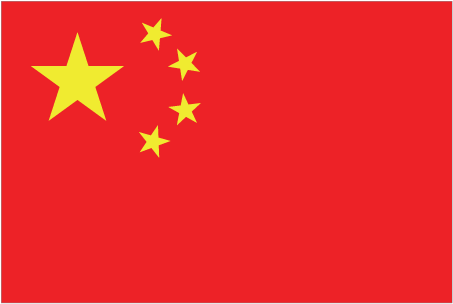
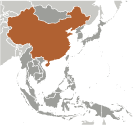
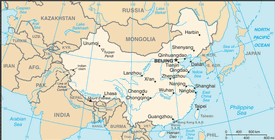 officially the People's Republic of China (PRC), is the world's most-populous country, with a population of over 1.3 billion. The
  Angola
  Guatemala